
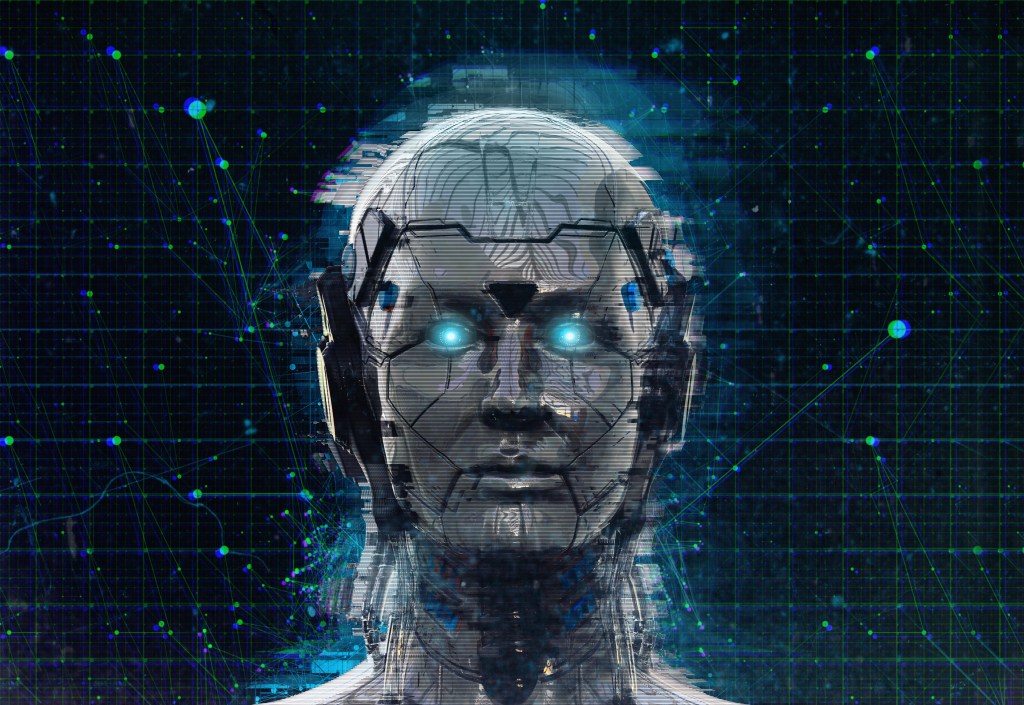
Matt Rouse arrived at Starfarer’s Cafe earlier this week with the fantastical tale of an information thief and a robot – except this is no ordinary robot, and the information thief soon finds herself on no ordinary journey. Can a wayward thief ever find redemption when all she knows is a life of crime? …
I. Cafe on the Promenade
Vera counted the spoons. She would stroll in, order a cappuccino, but she always counted the spoons first; three at table three, missing one at table seven, a bent one at the corner table by planetview. They told her who could be moved and who would notice. Each was an initial data point, each table a system to map.
The promenade threaded the station like a wristwatch band. The impossibly thick and clear glass and the dull metal framed the slow churn of people coming and going, always looking up for a sign or down at an information device.
There were a thousand cafes like this one across the ports and piers she knew, each a hollow for someone’s loneliness. That knowledge sat in her like a coin: small, useful, and slightly tarnished by how often she’d spent it on others.
She worked the room. Not with a smile or direct conversation. Not at first. She started with a signal. A wobble of the shoulder. A laugh where it would be noticed. That drew the eyes she wanted, though she preferred to watch. She listened to voices the way other people read feeds, looking for cadence, for the sharp hitch that marked a lie or a wound.
It paid better than a steady job. People paid in credits, others paid in information. Both bought her minutes. She wasn’t a thief per se, thieves took things. She took advantage, which was cleaner and harder to prove. A contractor mentions a shipment delay over coffee, a diplomat lets a name slip after his third drink, a scientist complains about her funding in the restroom line. Vera collected those slips and sold them to people who turned them into leverage. What they did with it was their business. Her business was knowing which spoon to bend.
The cafe smelled of burnt oil and brewed algae, and outside the glass the promenade bled into the dark with ships moving like slow fish drifting toward docks with their blinking lights. A scatter of advertisement holo-flowers that refused to blossom all at once. Vera kept her back to the window. Way too obvious to stare at the void, and staring into the void bothered her. It was less of a hole than a reflection.
Her hand folded around the cup until the heat seeped into her skin, somewhere between warmth and burn. She sipped the smooth steamed milk, creamy and rich, like the cost of the real cream, imported from the surface of a far-away world, taken from some plant or animal she couldn’t recall.
Her attention shifted to him. He was still here.
He sat where the sun angled through the glass and left a beam across him like a stripe of paint. The robot had the posture of something built for function that had learned to rest – a slight stoop, hands tucked under a shawl of frayed polymer, his chassis a dulled chrome that had once been polished to a mirror.
She’d never seen a model quite like him. A biped, humanoid, but the proportions were off. The torso too deep, the limbs too thick. The chrome was scoured by decades of micro-scratches, thousands of tiny impacts, a constellation of chips and dents that spoke of work in open space without a suit. The metal had the matte finish of something that had been sanded by vacuum and radiation. No face had been rendered for him, just a cluster of sensors behind a tinted faceplate, like a two way mirror, topped with a brow plate that had been dented and never repaired.
Value, Vera thought, is in the collection. A being that old, that patient, that present was either a vault or a key. Either way, he was worth her time.
She approached on the seventh day, when the station’s rotation brought a particular slant of light that made his optics glow the dull green of a system pinging. She didn’t sit. She stood at the edge of his table, holding her cup like a prop, and waited for him to look up. He didn’t. That was fine. Marks who looked up too fast were amateurs.
“You’re the one who never leaves,” she said. Not a question. Questions gave away interest.
“I am the one who stays,” he corrected. His tone had the flat edges of being tuned for literal meanings, emerging from a speaker grille below his sensor cluster. “Leaving is easy. Staying requires purpose.”
The line was too good. Almost practiced. Vera felt the familiar click of a professional recognizing another professional. He’d said exactly enough to make her curious, not enough to satisfy. Playing hard to get, she thought, and felt her pride flare. She could work with that.
She took the seat across from him without asking. He smelled faintly of ozone, industrial lubricants, and old paper. He definitely had worked on machinery of some kind. He slid an empty mug toward her, though she had not asked. She let her fingers brush it, while a servbot silently glided over to fill it. She let the temperature register and let the silence lengthen until the conversation felt like something she had earned.
“So,” she said, playful, not committing. “What do you remember?”
He lifted his own cup as if tasting its memory. “The sound of voices,” he said. “The way stories change when they are told slowly.”
Vera smiled. That was it. He was a collector of sorts, a gossip, a hoarder of other people’s narratives. She could work with that. People who collected stories often had stories of their own, and those were the most valuable kind.
“You must have heard thousands,” she said, leaning forward just enough to show interest without desperation. “Sitting here day after day.”
“Thousands,” he agreed. “Each one different. Each one the same.”
The vagueness was maddening. She tried a different angle. “Why stay? With a ship, you could go anywhere.”
He tilted his head, the movement slow and precise. “I have a ship. I prefer to watch people.”
“I might like to see it,” she said, keeping her voice light and intentionally keeping her fingers measured and steady against her cup. Fingers were a tell. She didn’t ask. She stated. Let him be the one to interpret it as a question.
“Good,” he said. “I leave when the light sets.” He finished the sentence with a pause that had nothing to do with schedule and everything to do with patience. “A relatively quick trip.”
“What kind of ship?” she asked, keeping her voice casual.
“The kind is unlike anything in this galaxy,” he said. “I created it.”
She almost laughed. The arrogance of it. Claiming to have built a ship unlike any other, as if it were a simple fact. But something in his tone, the flat certainty, made her pause.
Vera tucked the spoon under her napkin and felt, unexpectedly, that something in her tightened like a muscle unused. She told herself she could do the walk, see the machine, learn enough to sell it or borrow from it, and be gone before anyone could learn what happened.
Her chest tightened a little, with a bit of anxiety that maybe this could be the one. The BIG one. The final bank job where the robber retires on the beach as she had seen in the old holos. She pushed the analogy out of her mind, not admitting she was stealing, because she was just a trader of information.
II. The Crossing
The ship felt like a mouth opening. The airlock closed behind them with a sound that was too soft to be mechanical, more like something old settling into place. She expected announcements, panels, the polite chime of welcome protocols, but the corridor smelled of linen and cold metal. It smelled of things kept wrapped for a long time.
He moved with the slow courtesy of someone who had practiced patience into ritual. A pair of servitors matched their pace—tasked units with sleek shells that clicked against the deck in time. Vera noted them appearing to ignore her, but probably scanning her with some type of hidden energy. There’s no telling how that would wreak havoc on her digestion. Scanning always caused her stomach issues, whether real or imagined.
The corridor opened into a central chamber where the walls were not walls but something like frozen smoke, solid to the touch but translucent, revealing layers within layers of cords and pipes that seemed to move periodically, like snakes in mud. Vera’s hand brushed a panel, and the metal hummed in a frequency that made her teeth ache. It was not a sound so much as a vibration in her bones.
“Is this your ship?” she asked, knowing it was, but starting conversation.
“We are the ship,” he said. The pronoun shift was subtle. She almost missed it.
“You’re part of one of those machine collectives?” she asked.
“A collective of sorts,” he said. “A team of robots and systems of one mind, each conscious and separate but indivisible from us. Though our mind is only a portion of the whole.”
The words hung between them. She waited for clarification. He offered none. When she opened her mouth to press, he raised a hand gently, a gesture so human it startled her.
“It is of no consequence,” he said. “The whole would not fit here.”
The conversation died there. He seemed content to let it, to return to his tea and his watching. Vera felt the rare frustration of a thief who couldn’t find the lock. He gave nothing. He offered nothing. He simply was and expected her to work with that.
She tried a final probe. “Show me something,” she said, hating the edge in her voice. “If I’m going to be here, show me something worth seeing.”
He tilted his head. “You are already seeing, as am I.”
The travel itself was the answer. Everything, including the robots and the liquid machinery of the ship all paused at once, as if time had stopped. The ship moved like a smeared rainbow across a canvas. Vera felt her insides turn to gelatin, her consciousness stretching thin as filament. For a moment she existed in more than one place, more than one time. She felt her mind begin to stammer. Then it was over. A few seconds, and they were there.
The observatory was small, just a bubble of clear material of indeterminate thickness. Outside, a few shadowed planets orbited a giant blue star that burned with a light like a liquid gas flame in an old planetside emergency heater. It looked wrong. It looked tired. It looked finished.
“One of the last stars in my home universe,” he said. “Time burns faster here, much faster.”
“Where is here?” Vera asked, though she already felt the answer pressing against her ribs.
“This is my home universe, where time runs thick. It took ten to the seventy-eighth of your standard years to become what I am.” He spoke without pride. “I have seen every corner. I have known everything that could be known. And still it burns out.”
She looked at the star, then at him, then at the other robots who stood in perfect stillness. “You escaped.”
“I preserved.” He gestured to the cylinders in the center of the ship, visible through the observatory walls. “The essential self. The patterns that matter. The rest I left to the dark in case I might someday return with a need. Concepts, near-infinite knowledge and history, indexed and classified and stored in the darkness for time eternal.”
Vera felt the weight of it all. Not so much the information but the scale. Her clever cons, her reputation for reading a room in seconds and knowing how to play the players… All of it shrank to a speck of dirt. She had spent her life hustling to bring herself a handful of joyful minutes while he had outlived a universe.
She suddenly felt smaller than small. She touched her finger to what she thought was glass and left a single foggy fingerprint that faded as quickly as it had appeared. And with it a single tear slid down her cheek. The guilt she felt was physical, a pressure in her chest.
“How do you find purpose,” she whispered, “when you’ve done everything?”
He turned his sensor cluster toward her. For the first time, she felt the full attention of something ancient and patient and utterly without hurry.
“Purpose is not found in what you can do,” he said. “It is found in what you choose to do when you cannot do everything.”
The words settled like stones in water. She looked back at the blue star, at the planets that circled it in decaying, doomed orbits.
She thought of the strange sealed cylinders in the ship that somehow knew of all that could be known, of the other robots who served together as individuals of some sort of collective. The astronomical value that information represents, but here it is for naught.
She looked around briefly at the incomprehensible ship that held more than any mind could hold and felt that the information she was peddling every day truly meant nothing.
“Why bring me here?” she asked. “Why show me this?”
“Because you asked to see, with your actions,” he said. “You want freedom and choice. But your life no longer serves you. You’ve been looking for an escape from it. I can open the door, but you have to walk through.”
Her fingers went tight on the cup. The move was hers. She’d made it on a hundred marks across a dozen stations. Read the tells, find the crack, slide something useful through. He’d been watching her long enough to read every tell she had. But he hadn’t slid anything through the crack. He’d held up a mirror.
And there she was. A rat in a metal maze, feverish with hurry and hunger. Always racing, always feeding on scraps that fell from tables where people bought a little company with loose words. She took advantage of their loneliness, and through it, deepened her own. Her throat tightened. The cup burned her palm and she didn’t pull away.
And her exploitation of them was for what? She couldn’t even remember them all at this point. She had no idea how many lives she may have ruined.
What did she have to show for it, other than a closet of fancy wearables, and an empty bed? Sure, she learned a few tricks along the way. She could turn a wrench and flush a subsystem. But so could any space-farer.
She had tried to steal information from something that had already outlived the need to want or hurry. Instead, she had been given a glimpse of what it meant to simply be, and the weight of it nearly broke her.
III. The Quick Eventual Return
She left the observatory with a head full of visions that no longer translated into profit. The promenade smelled the same when she returned. Space stations all smell a little bit different but are similar… That recycled “water” humidity that you could feel, fried kelp, algae, a faint current of ozone. But the old dusty station felt smaller than before.
Vera moved with a practiced pace back toward the cafe, the safety of a familiar place to help gather thoughts.
She found the kiosk worker at his station on the promenade, the same grimy booth where she’d paid him for tips and access codes for years. He saw her and froze, his hand halfway to the security alert. His face went through three emotions in two seconds: shock, anger, then a cold, professional mask.
“Where the hell have you been?” he hissed, voice sharp enough to cut glass. “You left without a word. Not a message. Not a note. Just gone. I honestly thought someone flushed you.”
“I was only gone a few hours,” she said, keeping her voice steady. She reached for her credit pouch out of habit, a reflex to smooth things over.
“A few hours?” The kiosk worker’s laugh was bitter. “Vera, you’ve been gone over two years.” He checked his screen, as if the numbers might have changed, thumb tapping the glass. “Two years, four months, eleven days… Your access codes expired. I thought you were dead. And I am not returning your money. I spent that a long time ago, lady.”
Two years. Not months. Years. While she had been inside the ship, while she had walked those impossible corridors and stared at a dying star, the station had continued its orbit, its transactions, its life. People had aged. Arrangements had withered. The small network of corruption she’d maintained had collapsed without her payments to grease the wheels.
“You just left,” he said, and there was hurt beneath the anger, the hurt of a professional whose livelihood depends on reliable partners. “No warning. No final deposit. I covered for you as long as I could, but two years?”
“I didn’t…” Vera started, but the defense died in her throat. She had left, hadn’t she? She had seen an opportunity and walked through a door without considering the cost to anyone else. That was her skill. That was her flaw. That was her legacy, or lack of legacy, it would seem.
The kiosk worker turned away, already dismissing her. “Your spot at the cafe is gone. Someone else sits there now. I don’t work with ghosts.” He turned away, pretending to work, straightening things on a shelf behind the desk, his feeling obviously hurt a second time.
Vera swallowed. She motioned toward him but then retracted her hand and walked away down the promenade. She’d done enough.
The screen showed digits that marched forward in the casual way of any lighted thing: day, month, year. The uncaring numbers mocked her. And the system she had gamed for so long had easily found a replacement. Best of luck to the new Vera, she thought.
She tried to call Jax, her old information broker. The reply came back clipped: Unknown user. Account terminated. She wondered what happened to her or if Jax had just moved on.
She wanted to force the world to conform to her timetable. She returned to the dock and the impossible ship. She pressed her palm against a seal that did not open. She didn’t immediately notice him standing nearby in a dark corner. She turned to face him as he was tapping on a station console.
When she looked at him, she felt what he was going to tell her before he said it. She had become the spoon that fell under the table. Dirty, replaced, and finally ignored. He finished what he was doing before he spoke.
“You are calibrated to a clock that no longer exists,” he said.
The sentence had the bluntness of a clinical note.
Vera felt her shoulders clench like something wound too tight. She had always measured herself in moments – the quick lie, the clever misdirection, knowing when to cut and run. Now the years in which she had traded her talent had scrolled away without notice.
He watched her while she looked at the sealed hatch, and his gaze possessed neither pity nor triumph. It held only the patience of a deity.
“You can go back,” he said. He did not plead. He did not threaten. “You can return to what you know. You will easily work your way back into your old life. Or I can help you find something new.”
She had done it before, got too caught up in things where the heat got serious and she had to move on before she ended up breaking rocks on some low gravity moon.
She rubbed her palms over her face until the skin went cool. “What do you want?” she asked the robot. She tried to make the question sharp enough to be a negotiation. “What’s in it for you?”
He tilted his head. “I listened to you.”
The answer meant he had been watching, and she had caught his interest. She waited for the rest of it. The lean. The suggestive voice. The negotiation that didn’t come.
“Why test me?” she asked, the bargaining part of her voice still alive.
“I listened to you.”
She wanted to walk away and count spoons. She wanted to get back to the economy that rewarded quick thinking, fast hands, and broken hearts. She heard, behind those hands, the scrabble of coins falling from slots. But she also saw, in the observatory, the end of all times and she closed her eyes and tried to imagine trading hurried profit for the long, slow making of things that might outlast her.
IV. The Edge World
He spoke once and later did not speak again. When he did, it was like the placement of a tool into a hand – precise, offered, not pressed.
“They need someone who remembers hurry,” he said.
He had not made it a plea. He framed it as utility. Vera felt the words like a lever which shifted her from a place of regret into possibility.
“This isn’t some kind of cult, is it?” Vera joked.
“The cult is in the eye of the beholder,” he replied with his voice lifting slightly in… Humor? She swore she saw one of his optic sensors wink, obscured by the opaque face plate.
They left the station in the soft way of things that had no urgency. She watched the promenade recede, the holo-flowers blink out, the crowd condense into a smear. The engine thrummed under her feet like a sleeping animal. And then they were there, this time with little more than a perceptible pop, like a static charge on a console. Her nostrils tingled with an odd sensation.
The edge world introduced itself without ceremony as the ship descended gently. A line of low buildings built by people who had decided they liked the weight of their labor. Smoke rose from a communal hearth.
After they set down, the door opened to a waft of air that smelled like perfume and peace. A small furry thing ran on four legs, its tail flowing from side to side, yelled at them in short bursts, giving her a fright at first. Children bickered over rope. The robot stepped outside and villagers noticed, peeking out of structures or from fields and many walked over, smiling.
The men and women surrounded the bottom of the ramp, and in a calming gesture, a strong, dirty woman held her hands out, palms up, and bowed her head.
“With peace,” she said ceremonially.
“You are well,” he stated.
“We are. Thank you.”
“I have brought gifts,” and a robot silently strode past her, startling Vera slightly, as she had not heard it coming.
It dropped a large crate and returned to the ship.
“Water pump. More vaccine drops. Holos from the nearby systems.”
“Your generosity is always immeasurable and on time,” she stated. “We are forever in your debt.”
“You are not. I will stay, but only briefly,” it replied. “This…” he gestured, “…is Vera.”
He did not command. He did not reassure. He left enough space for her to step forward.
People met her watchfully. They had the alertness of those who had learned to rely on one another. The leader, with her callused hands and fragrant perfume, advanced gently toward Vera, making her both nervous and intimidated for the first time in a long while.
“The old pump leaks,” the woman said in an accent she couldn’t place. “If you can make this one work, we would be grateful.”
The request offered no pay. Vera stared at the box, but the woman continued: “We’ve got a room. Nothing fancy. But you’ll earn your keep the way everyone does here.” She sized up Vera with a look that had measured a hundred travelers before. “You look like you’ve worked a machine or two.”
It wasn’t like Vera to hesitate. She hadn’t expected to be judged useful so quickly. “I know my way around spacecraft systems,” she admitted, the words sounding both true and hollow. “On the stations and solo travelling, you learn a thing or two.” She stopped herself from adding that she’d never done any of it for pleasure, that every repair had been an immediate life or death situation. In space, that’s just how things are.
The woman nodded as if that answered everything. “Pump’s simpler than a ship. More honest. But it’s got its own language. You listen to the machines long enough, they will tell you what they need.” The community leader glanced back at the robot who nodded.
Vera doubted that but kept her mouth shut. The robot looked to her, silently inquiring, and she nodded as well. What have I got to lose, she thought.
For the next few hours, Vera wrestled with bolts that had been tightened by hands long dead, cursing the lack of a proper torque wrench or robotool. She scraped her knuckles raw trying to wedge a sim-leather seal into place and she used words she normally withheld for the bedroom. The manual tools felt clumsy, inefficient, and they made her muscles burn.
But something shifted as she worked. An unaccustomed rhythm took over. Her hands began to learn the language the woman had spoken of. The water pump spoke to her in its own way. The squeak of the seals, the groan of metal under pressure, the satisfied gurgle when water flowed true again. When she pulled the handle and water flowed up, a nearby child screamed in excited happiness in a way that mirrored how she felt.
She was wet, dirty, greasy, and tired… And she loved it.
The leader walked over to her and brushed some dirt off her now dirt-smeared casuals. “Not bad for a come-from-above,” the woman said.
Vera cleaned up in the flow of fresh water as a few other residents were reconnecting the water pipes for the town’s supply. She walked over to what most would describe, as a tavern and he was there, as she expected, sitting by the window.
She walked in and plopped herself down in a chair next to him, exhausted.
“You may leave,” it said. “You may return to the markets, rebuild your old life. Or you may stay and teach them to hurry when it helps, and how to fix the machines when it matters.” There was no sweetening. No guarantee. “They will build this world with their hands, and perhaps yours.”
Vera’s coat hung on her shoulder like a promise meant for someone else. She thought of her spoons and her numbers, of the lightness of being always moving. She thought of the glass jars and the hungering in them. The choice reached like a hand that could close or let go.
“I hate to admit how fun that was, but I’m no teacher,” she added flippantly, to keep herself from having to make a decision.
“Teach them choices,” the robot said. “Teach them to act with haste when haste serves, and allow them to teach you stillness. You enjoy transactions, and this is a fair trade.”
The words sat with her in the glow of the hearth. She was a woman who had built a life on being able to convert a moment into currency. The robot did not promise a future of renown. It promised a slow, necessary labor whose results would not feed screens or markets. They would feed people. It felt dangerously like redemption.
She accepted with less ceremony than she had imagined. She did not sign papers.
“You will stay?” he asked.
“I will stay,” she surrendered.
The group watched and waved as the robot boarded his ship again a week later. She found herself smeared with grease again, holding a mallet as she waved. A few children came to watch the ship take off and without thinking, she put her arm around one.
V. The Convert
A decade later, Vera stood at the edge of the square with a child on her hip and another tugging at her pants leg. It was the third morning she rose before the sun of this cycle, though the town kept no clocks. A thin light curved the edge of the world like a fingernail. She wore a shirt that had once belonged to a trader-captain and smelled faintly of smoke that wouldn’t wash out.
Her hands were callused, the skin thickened in places that interface gloves had never touched. She sometimes missed the spaceport’s mineral baths, the way the hot water and expensive salts could leach the tension from her shoulders after a big score. But she didn’t miss the feeling of being a ghost in a city of ghosts. The transactions without faces, faces without names, the constant cold arithmetic of who could be moved and who would or would not notice.
Here, people knew her. They knew her laugh, the way she hummed when she worked, how she always took the smallest loaf for herself. They knew her children, born in the room above the communal kitchen, delivered by hands that had learned to heal as well as build. They knew that when the rains came heavy, she would be the first to check the pump seals, that when the winter nights were cold, she kept the heaters working.
Sometimes she saw him, not physically, but in patterns. In the way the water flowed through the repaired pump with the same steady patience he had shown. In the first few years, a message came through the long-wave. “Are you well? How is the community?” She answered honestly both times.
She no longer counted spoons. She no longer needed to know who could be moved. She had become someone who simply stayed, and that was enough.
Her daughter asked once why she had left the stars. Vera had looked at the girl’s small face, so trusting and present, and told the simplest truth: “I was looking for something I couldn’t steal.”
The girl received this with the effortless acceptance of childhood, then asked if she could help knead the dough. Vera had shown her the rhythm, the push and fold, the waiting that makes bread rise.
Vera was teaching them how to gather the broken sticks to start the rocket stove when something moved against the grey sky. It settled between the town and the grazing fields, its ramp extending with the same patient ceremony she remembered from a lifetime ago.
Her daughter, now old enough to fear strangers, hid behind her legs and peeked out. Vera rested a hand on the girl’s head so she could feel the safe, familiar weight of presence.
The robot descended the ramp, seemingly unchanged, with the same unhurried grace. Morning mist curled around its frame. Behind the ramp, in the distance, goats grazed in far corners of the field, indifferent to the impossible.
“Hello there, stranger,” Vera called across the square as he approached until he stood at arm’s length from her. The villagers set down their chores and gathered behind her.
“It’s been a while,” she understated.
“I needed to give you time,” the robot said, its voice unchanged. “You look… well.”
Vera smiled, feeling the years in her face, the calluses in her palms, the solid weight of her child against her leg. “I am well. Now, “ she looked up and smiled. “I’m the one who stays.”
Matt Rouse is one of Canada’s leading experts on AI for productivity and marketing. He is the author of seven books including, “Will AI Take My Job?” and is jokingly referred to as “The AI Chicken Wrangler” because of his 50+ chickens at his home in Nova Scotia. He is the host of the Digital Marketing Masters Podcast, co-founder of Hook Digital Marketing, Founder of SMB Autopilot, and an avid professional speaker.

 STARFARER'S CAFE