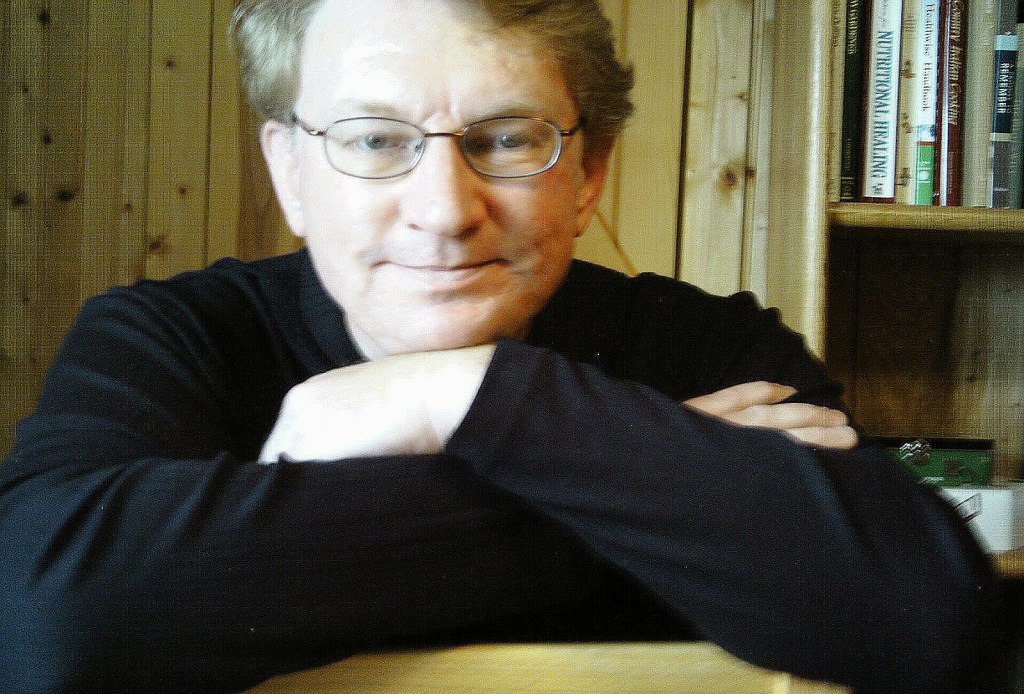
Starfarer’s Cafe recently sat down to talk with science fiction author Rob Bignell, whose short story All or Nothing is among the first to appear in our digital magazine. A long-time book editor, Rob also has authored more than 80 titles – mainly hiking and writing guidebooks. He writes science fiction as well, with All or Nothing his third short story in the genre to be published. Here’s our interview with him.
Q: Why write science fiction? What drew you to the genre?
What appealed to me about the science fiction genre is that it was escapist yet relevant. I’ve always had a philosophical bent to my thinking, even as a kid. While literary fiction might discuss affairs of the human condition, it too often lacked the suspense, tension and intriguing settings of science fiction, making it a real drag to read through. While other genre fiction such as action-adventure tales, detective stories, and westerns had the suspense, tension and intriguing settings, often there was no message other than the lame “good always overcomes evil.” Reading them felt largely pointless. Not so with quality science fiction. Stranger in a Strange Land didn’t just tell the tale of mankind’s first meeting with an alien but explored social norms and the potential for human transformation. The Ones Who Walk Away from Omelas didn’t just take me to the summer festival of a shimmering, utopian city but also caused me to question my responsibilities to fellow human beings as a citizen of the wealthiest, most powerful nation in the world.
Q: What authors or books (sci-fi or otherwise) have most influenced your writing?
I’m very old school – H.G. Wells’ The War of the Worlds and The Time Machine, the short stories of Fredric Brown, Clifford Simak, Murray Leinster, Robert Silverberg, Poul Anderson, Arthur C. Clarke, Ray Bradbury, and Larry Niven, and original series Star Trek. I do read the new stuff that comes out, but if I hit a stumbling block when writing, I always ask how did one of my favorites handled it, not how the newbies did it.
Q: How do you decide what you’ll write?
Any story I write has to have a conflict. Without that, I don’t have a plot or an interesting character. Ideally, the story also explores some theme relevant to current times and has an interesting setting that creates atmosphere for playing out the plot. When I have all those elements, I get excited about the story idea and start writing.
Q: How did you come up with the idea for you story All or Nothing?
The idea came to me while I read an article about black holes at the magazine stand in Target as my wife at the time shopped. No one wants to fall into a black hole, but what if the opposite were true for several civilizations? Of course, the rebel would be the one individual who didn’t want to fall in.
Q: Can you share a memorable moment or scene from All or Nothing that sticks with you?
When the alien pilot trash talks Evod, who gets mad like a teenage boy. It’s a minor point in the plot, but such details make the story feel real while adding pressure on Nevar to succeed.
Q: What is best writing advice you’ve ever received?
Show don’t tell. Most people don’t understand it. It doesn’t mean never tell. It means let showing dominate. Almost all of us when we start out as writers like to tell rather than show, and as soon as I broke that bad habit, I started getting published.
Q: What areas of scientific developments interest you most?
My interests are fairly wide. Astrobiology, astronomy, theoretical physics, evolution and geology articles almost always garner an instant read from me. Those topics show up way more in more stories than something I’m less interested in, such as biology or medical science.
Q: Have you noticed any particular trends in sci-fi literature that excite or concern you?
Science fiction always has been a genre of trends. It reflects the times we live in. Today, dystopian, underrepresented voices, and experimental are all the rage. I won’t criticize any of them because that would imply good stories aren’t being written in each of those areas when in fact they are. At the same time, that’s not all that’s being written. A lot of us are writing hopeful stories that explore novums and feature main characters who grow and change. I do hope that’s the wave of the future, because I’m bored with most dystopian tales, and experimental tales lose their edginess when they become mainstream.
Q: Your main job is editing books. Do you edit science fiction?
I do. Science fiction, fantasy and horror manuscripts make up about half of my workload. Editing does make me a better writer, as I’m always trying to make sure I don’t do the things in my stories that I tell other writers not to do in theirs.
Q: What are you writing now?
I’m wrapping up my first science fiction novel, Projekt Feuerball, and compiling several of my science fiction stories into an anthology, Achieving Orbit, both set for release this November.
 STARFARER'S CAFE