
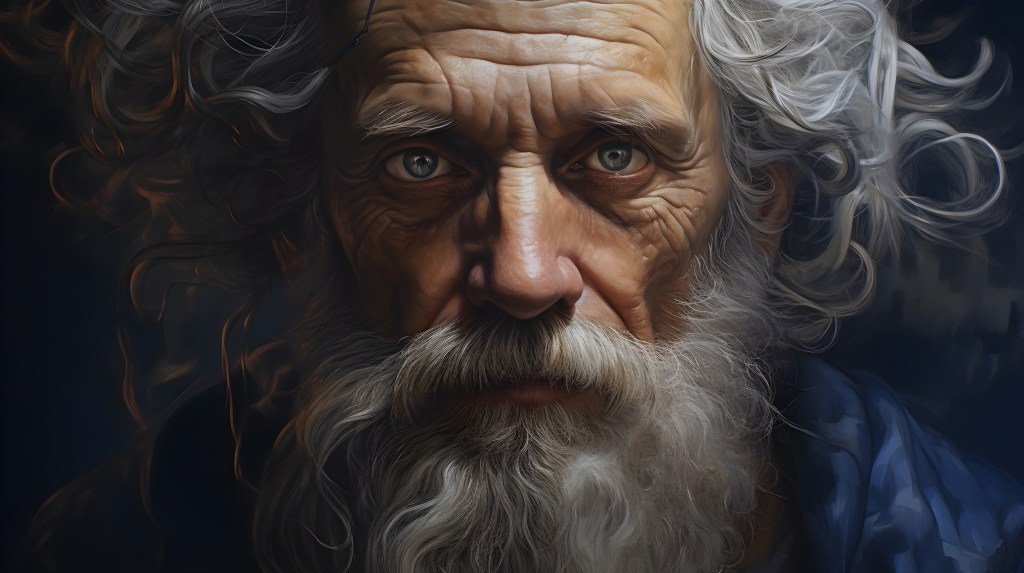
Dennis M. Kohler visited the café this past week, sharing the tale from a distant world of an old man facing his mortality. But before he dies, there is one last task to perform…
He watched as the pair of cats dove up over the surf. The fish they had swatted with their huge paws, stunned and motionless, drifted back to shore.
The waves beat a cadence and allowed him a moment to marvel at what he had done.
He was not a man who allowed himself a great deal of pride, but neither was he a man who allowed himself self-deceit.
What he saw, the great beasts that he had created, were worthy of a moment of true happiness. It was a moment he allowed himself to relish. He had never been allowed to be a father. His genes were property of the clan, but he had never known the joy of raising children. He knew, in his heart, when he looked out at the green and black fur that glistened in the surf that he had a sense of fatherhood.
He watched carefully as he put his sandaled feet into the smooth organic footholds that had been broken and beaten during the thousand years the surf had caressed the rock.
Careful, he thought.
He didn’t have many years ahead, but those years he would want to spend in pursuing the pleasures of the world, not broken and limping, not left as a sacrifice to the nightwalkers.
“Kora! Thal!” he yelled. “We have enough, come to me so that we might collect the fruits of your work.”
Like two ballet dancers, they surfaced and dived, coming inward until their feet rested in the dark black sand.
They waited until he was upon them before they chose to shake the water from their coats.
He sputtered and dripped, but laughed, patting each of them on their heads, scratching their ears until they rewarded him with the low throat rattle of affection.
“Only fair, I guess,” he said, “you have done the work, so I may as well suffer a bit of the cold and wet.”
But, he only stayed cold a short moment before he was hurrying down the beach to collect his share of fish both large and small who had been dispatched with tooth or claw to drift slowly inward.
Five to his one they collected in gentle mouths to deliver to his waiting baskets, five to one, and the work was soon done.
The old man carefully bound the tops of four baskets with damp burlap then rolled the baskets into wooden travois frames. The two big cats crawled into the frames and stood. He could tell that even though they were willing to haul the baskets, they were not beasts of burden.
He could see it hurt them to be constrained by the leather thongs, but they moved forward without complaint, and soon they were on their way up into the woods. Up to his people and to the chief who would accept the gift of the fish but continue in the night to talk about Oto Renzi, The Father of Cats, and how he had brought great ruin down upon them.
The sun of the goldilocks zone planet warmed him, and for a moment he allowed himself to experience the joy of it. This was a colony world, settled by the seed ship now two generations past. It had been full of promise, teaming with the life that had been planted and allowed to flourish before the human colonists were awakened, and allowed to walk out on this land of immense bounty.
The moment of joy was short-lived. Oto Renzi, the outcast scientist who had toyed with the very structure of human life itself, remembered the cause of his isolation.
He remembered, as he always did, the words of the great chief. He remembered the odd looks that misapplied beliefs taught the children to throw. He remembered that he would never have a wife or a child. He convinced himself that it meant nothing to him. He was proud of the children he had made, as proud as any father.
It only took two times of overtaking the cats on the trail before he realized that they were, as usual, holding back to assure his wellbeing, on the second time he scolded them.
“Run,” he said, “fast as you can to the village, then if you wish, return to me, but get out from under your burdens as fast as you can.”
They listened, and he heard them crash through the forest, in a race to see who could first go then return.
When they returned to him, he had made it less than a mile back toward the village. Their sense of smell allowed them to find him curled up under the roots of a giant worship tree.
When he woke, it was the following day, Kora and Thal lay either side of him giving both warmth and protection.
“Just stopped for a quick rest,” he said.
He knew his day was soon to come, but not that morning in the glorious sunrise that drifted down through the triple tiered forest. Not today, he knew, as he stretched out the soreness from his ancient legs.
Thal, who was a better climber, vaulted up into a char fruit tree that had gained its name from the delicious fruit as large as a man’s head. The fruit were poisonous to his kind until they were burned, then they yielded a sweet pudding that acted both as sustenance and analgesic. It was just what he needed, and as the large fruit began to fall around him, he was already making a fire from the fallen branches that had accumulated under the roots of the worship tree.
He added the leg of a large ground loper that Kora had collected while her littermate was about the hunt for fruit for the fire. He sat back and waited and tried to not concentrate on the crunching and gurgling serenade of his friends making work of the still warm loper. He tried, and failed, to enjoy his own breakfast half as much as they relished theirs.
When the recuperative effect of the char fruit had worked its magic, he poured the remaining pudding into his vacuum flask and put out the fire. It had taken his people three generations to learn how to live on this world; many had died to learn the lessons of botany and chemistry that were unfailing in their swift, dramatic justice. He was the beneficiary of the knowledge gained from each of their mistakes. He thanked his ancestors for what they had given him as he walked along the path led and followed by his friends.
When they reached the fish drop point, the baskets were gone. The harnesses were scattered in the tall grass by the flat rock that had become their altar to belonging. He simply shook his head, reminded himself of the last time he complained, then bound the harnesses in the manner he had always done and stowed them in a small, unmaintained hut with a leaky roof.
The new generation was not the same as the last or the one before. It was and would always be that way.
“Come, let us watch them from afar, and learn of their ways,” he said. It was a line from the book his father would read to him as a child. Their ways, he thought had been his ways, but they were no more.
***
They had not reached their observation point when they heard the screams.
To call what passed as the horrified whimpering of a thing so badly in duress that any vocalization came only as a throaty whisper was more than unkind. To the ears of the big cats, it was more clear than what he had heard. Then he heard it again, more clearly this time. He realized as he moved toward the village that the sound came not from an it but a they. There was a multitude of voices crying out in a chorus of suffering. Then he was off at what passed, for him, as a run after the big cats who responded more from curiosity than from care.
The cats waited for him at the mouth of the clearing that bore the symbols of ostracism that they were not allowed to cross. They looked to him for permission, then they resumed their back and forth search pattern, which, if it had shown results would have them springing from their readied coils of massive muscles.
“Let us go in, but be slow and careful,” he said through the gasps of wind escaping from his overburdened lungs.
They both stood and crawled forward, heads up, eyes alert.
He followed close, more afraid, he realized, about what the villagers might do to him than from what might have come from the woods. Up until that day, the only beast on that planet who he knew capable of killing without threat or warning were the descendants of his own people.
Step and wait, and watch, he said to himself.
The scene at the communal hall was horrific. He was greeted by two half children staring blank eyed with hands grasping what was left of their stomachs. The look of fear was still in their faces. He knew they had both realized what would become of them before they had perished.
What small piece of what was left of his self-control faltered. He felt the cool rush of pure fear reach up through his spine and grip him by the back of the head. He remembered the face of the one boy who lay dead at the same moment he saw what had become of the pair’s legs.
This was one of the boys who had come to fetch the fish. Just like his father had before him, he inherited the job of going out into the wilds, outside the wards of safety and up to where the old man left his offerings. The old man saw a vision in his mind’s eye of what this mangled corpse might have looked like carrying the basket of fish back to the village only a day before.
The boys’ legs were strewn akimbo across the path that led to the house as if the same thing that had torn them away had lost interest at the sight of something better.
He tried to imagine what might have wrought this carnage by inspecting the trail of blood from the mangled pair up the stairs to the great house, but he could not. There was no painted sign of man or beast in the blood trail, simply a broad red swath that fueled the sadness in his heart.
The volume of the cries increased as he pushed the doors inward toward the stone hearth at the head of the great house. As the light from outside reached the wet shining eyes of the children, their whimpers turned to screams of terror.
The sound brought the two cats running. They were, however, blocked from entry by the old man. He did not know what the children had seen, what they had been through. He did know that whatever it was would not be helped by the sight of the same beasts that populated the stories their parents had used to frighten them into good behavior.
“Come little ones,” the old man said in the highest voice his strained and aged vocal cords were capable of producing, “we mean you no harm, you are safe with us.”
Like a magic spell, the words they recognized in the language of their people acted as a talisman to free them from the chains of their fear.
He was surrounded on all sides by the small and delicate hands of children reaching up beckoning him to lift them and give succor.
“Do you hear anything?” he yelled at the door.
“Nothing,” the pair of voices, hard, harsh across lips not designed for human speech, lower and less eloquent than even his own, replied.
To his ears, well practiced at the most foreign accent that had ever attempted the language of his people, spoken in protest, the message was as clear as any he had ever heard.
“Come children, we will walk to the woods, close your eyes, and take the hand of him in front of you. Close your eyes and follow.”
He took the hand of the smallest child and led them forward, outside the safety of the village and into the woods. Only when he felt they were a safe distance did he stop. Only then did he remove the clothing that covered them so he could tell if the blood they wore was their own or that of others.
He washed each of the seven until he knew they were unhurt. Then he built a fire and watched until each, one by one, ceased to shiver.
He was thankful for the time he had to think.
“What, tell me, happened in the village?” he asked when he felt they were warm enough to speak.
One child screwed up the courage to speak. She was the smallest, he thought, but they all looked so small and vulnerable like hairless rats fresh from their mother’s womb. Hairless rats who, he discovered, could speak.
“It were the damned nightwalkers,” she said.
He blanched a bit at the notion that one so small would speak with such obvious hatred.
“And you saw this, little one?” he asked. “What are you called?”
“Allie,” she said.
Then the weight of it was too much. Not even the littlest one spoke. In the silence he tried to make himself smaller, less threatening, he even tried something he had not accomplished in very many years.
He smiled the communicative smile of a human, not his natural resting smile of deep happiness. “Why would you think it was the nightwalkers?” he asked.
“The drums,” the little one said.
Then each and every head in the small crowd bobbed in agreement, some even used what strength the horror of the experience had left them utter a small sound of agreement.
“Drums,” they said one after another taking up the chant, drums meant nightwalkers, a fact he knew well himself.
He added fuel to the fire and encouraged the little ones to lay down, and soon with the soporific nature of the heat and the dissolution of will from what they had seen, they were in fitful but blessed sleep.
He moved to the edge of the glow of the fire and called to his dear friends.
“What do you make of this…” he asked, then before an answer was offered he spoke again, “pure evil?”
Then he paused and waited for an alternative theory.
“Walkers,” the big and clearly agitated Kora purred.
His sister simply looked at the sleeping children and shook with tension.
“These were the ones who banished you,” the Father of Cats said, “the same who might one day have come and taken your life.”
“Walkers,” Kora again purred, “kill Walkers.”
Then he and his sister paced and pawed and snapped their teeth.
“Run you, and be careful. Bring anything you see from the village that will help us care for these children; forget not clothing and food. And look for signs of walkers.”
They left him alone with the last words of his message in his mouth, alone like a stone gargoyle he perched on the rock and watched the sleeping children. Then, he perched waiting for an idea like a dog who keeps his master’s house safe for his return.
He remembered the sad days following his ostracism, the days in his laboratory, focusing on his experiments, focusing on the creation of the big cats, modifying, splicing, creating new when established material did not prove worthy.
In those days, he had predicted that this day would come. He had predicted that the schism between The Walkers, those who journeyed out into the unknown, and the people they left behind, might come to open conflict. In many ways, as a man of science, he feared the black void that held what he could not understand. The adherence to dogma, the partizan divide between what he had come to believe were the separate new religions of this world, was worthy of this fear.
Now, he thought, the parts divided have fallen back upon each other with this horror the result.
***
The idea rushed into him as a plan of attack. All at once it was there, like the ideas used to come uninvited in the night when his mind was young. Then he would rush to his lab and write frantically until the world around him woke with the sun. Now he simply said a prayer of thanks to whomever or whatever had allowed it to come.
The cats made three trips, first for food and clothing, then water bottle carriers and sleeping mats, then on the last trip they brought something that he thought he would never have a use for again.
He shuddered to think how the cats with tooth and claw had taken the pistol belt from the dead village warden, but there it was, soaked in blood, buckle still fastened. Out of the habit of an earlier life he pulled the pistol from the holster, checked to assure that it was fully charged, and started to clean it.
His hands worked mechanically, well practiced, trained.
The warden had been his friend, and the son of a man who was an even better friend. A man who had died to save the colony in the first days, and a man who he owed much more than his life. It pained the Father of Cats to think of the good genetic line that had been stopped by those who walked the night woods, but not so much that it allowed him to forget of revenge.
The following morning, he buried the gun belt in the same hole where he buried the children’s tattered, blood-soaked garments.
Then they turned their backs on the village forever. At least he hoped the seven who survived would never have to see the place again.
In the mountains, up high, he knew of a place. It was where the firstcomers had spoken of the birth of a proper station, the prime redoubt. He learned of it through stories told by his father. In the first days they had seen the opening and being builders had built. Like so much else, it had fallen on disrepair in the long days of struggle for survival.
His people had long ago given up the quest for knowledge for the immediate needs of skin and stomach.
The children as they walked became more comfortable with the big cats who brought them presents, and the cats took quickly to the responsibility of caring for the children.
If it hadn’t been for the walkers, the old man might have been tempted to take the children and run for the hills. But the walkers, once they had in mind something they wanted, were persistent.
***
Why did he not just turn and walk away? He certainly had done worse. Why could he not muster up the courage to simply finish his short life knowing that he could do nothing to help them, knowing that he was powerless.
He didn’t owe these people anything; if anything, their debt to him for the years of food provision was far from paid. Their lack of kindness would never be offset.
He had a code, it was his father’s. Set down an anchor and weather the storm.
On their own, the older children may have provided for the young, they may have survived with enough among their numbers to create a breeding pool. It had happened in other places. Ships had arrived to find lost colonies before. Perhaps, he thought, that was the source of the walkers. Perhaps they were just like the children once.
No, he thought to himself, they were not, they were nothing like the people they had killed, nothing at all.
That thought alone might make me feel better about what I am going to do, he told himself.
He had made the climb once when he was young, he had climbed up into the cave and watched his father enter the keys to open the vault.
He rolled the long and tattered sleeve up over his forearm and looked down at the inside of his wrist. He remembered how it had hurt, he remembered how he had cried. His father had said that there would come a day when the importance of it would make sense to him.
As he raised his arm to the glow of the monitor, he saw the series of numbers and letters appear as if they were on fire under his skin.
Slowly and deliberately he typed each of the symbols into the touchpad under the monitor.
The old research station was a mess.
The automated filters had long ago reached a saturation point where they could not overcome the decades of dust.
He hesitated a moment at the threshold then walked inside. It was much the same as a dozen other wide spaced redoubts he had investigated in an attempt to make sense of his childhood. It was very much the same as the one where he had discovered a way to bring his friends to life.
This was a station he had only one time before entered. It was the station, the mausoleum where he had laid his ailing mother to rest. If he could help it, the catacombs behind the entry were a place he would never go. In the beginning, before the schism, before the Walkers had separated from the Sky Farmers, the settlers had used the advanced technology to build this among the many research redoubts that has spread out across the lands. The knowledge of their use and purpose had faded through the years until only Oto Renzi remembered their purpose, and how to speak their language.
He looked across the dust that had collected in the long years of misuse. Only after he proved to himself there was no sign of the walkers – or ghosts – did he move forward to investigate.
By the time he returned to the children, the two big cats were pacing with a fervor that gave clear indication of their agitation.
“Too long,” said Thal.
The Father of Cats nodded in agreement. “We can’t be too safe, my dear, you know the penalty of recklessness when consorting with walkers.”
As if his words were puppet masters, she reached back and licked at the long scar on her hindquarters.
“Take up the children, and go you to the redoubt, once there follow your noses to where they will sleep.”
The two big cats tilted their heads with misunderstanding.
“Go, and you shall know,” he said.
He knew they hated having cover over their heads. It made what he was about to do much more a sin.
“Take care of the children, while I collect water,” he said to both of them and reached up and in turn gave each of them a chance to rub up against his long gray beard. Take care of the children, their order, when they were only children themselves.
“Kill walkers, after?” Kora asked.
“Yes, then we go and extract our revenge.”
He felt the horrible pain of the lie as he turned his back.
He waited until he was sure that they were all safe inside, then he triggered the remote security locks.
Inside the control room a series of red digits began to count backward from 72 hours. In three days time, the doors would open, and he would be waiting for them, or he would be dead. Only time would tell.
***
He knew where to find the nightwalkers. What they possessed in ability to create terror was more than made up for by their lack of creativity. They had lived in the same caves since they had first been contacted by his father those decades past.
It took him almost a day before he crossed over into their native land.
As he suspected, they were waiting. The name nightwalkers had always been misleading, the walkers walked both day and night, nightwalker was just a convenient nightmare that had been built to keep the children small and naïve.
How stupid he had been, and this current jumble of unintended consequences was what had become of his stupidity.
The chief met him at the circle.
The circle was located in a large open area shaded by trees overshadowed by the large rock cliffs of the caves. It was no surprise to him to see the motion of the archers as they moved into the cutouts that gave them full view of the circle. They stared at him, with dead eyes, over hand fashioned arrows.
Many times he had walked into the circle, promised the protection of their ways, promised that as long as he chose to parlay, he would be safe. Once the circle had been broken, however, once he had been given permission to leave the valley, he would be back among the numbers of outsiders, and as such under no protection of the chief.
It had been a dozen years since he had walked into the circle, but little had changed. The walkers, as they always had been, were oath bound to live off the land, to use no technology, to live in a way that was sustainable, that grew in parallel with the entire biome. It was a stark contrast from the people of the village who had fought to maintain the deteriorating technology.
The walkers selected their chief, and the chief’s word and interpretation of The Codex of Walker, the holy words that had been written by Walker himself in the first days after the split, were the only law. Oto Renzi had once seen those words, written in Walker’s own hand in the leather-bound journal. Words of wisdom words of advice that had been suggestions that became unalterable law.
The people left behind had chosen to run their society by committee.
“Who are you?” the chief asked with as much bravado as he could muster.
“You know full fucking well who I am, you fancy dressed chorus girl,” the old man said setting the stage. As soon as he said the words, he knew that they were those of his long dead father.
He also realized that he may have made a mistake. Underneath the ceremonial dress of the high chief of the walkers, he saw a younger man than he remembered from the last trip.
“I am the one your people call the Water Dancer,” he said, for a brief moment remembering the first of their kind who had given him the name. It was the memory of a time when his people and the those of the chief were close to ending the war.
The chief closed his eyes for a calming second, then opened them with a flash of what the old man, might have suspected anywhere but inside the circle as anger. “State your purpose,” the chief said with a tone as dull and emotionless as he had used when the old man first stepped into the circle.
“Right,” he faltered, “there seems to have been a small incident at the village.”
The chief looked at him with a gaze that was difficult to determine the origin of, so he took a guess that would prove wrong.
“The people who you call the Sky Farmers.”
The chief erupted into a string of the ear-splitting patois that he had, he realized, heard too often in his life. His ears had hardened to the meaning of the words, but his brain, still virile, managed to sort out that the man was asking for furniture.
Two of the younger men ran forward with heavy log chairs that had been worn smooth by the generation of buttocks that had slid across them.
They placed the chairs near the circle, refusing to break its sacred plane. The chief turned his back and removed the elaborate headdress. One of the archers screamed down at the boy who hadn’t seen the chief. The boy turned, but his movement to assist with the costume was beaten back by a fierce gaze that the Father of Cats could not see.
The boy stopped and watched the chief reach down and lift both of the chairs one in each hand and return to the center of the circle.
He motioned for the old man to sit, then joined him.
Only then did the Father of Cats look with earnest intent into the eyes of the chieftain. Looking back he saw a mixture, in even proportion, the eyes of the only woman he ever loved and the eyes of his father which he also understood to be the same as the eyes he was looking through.
“What exactly do you mean by incident?” the chief asked.
The old man, broken by the anxiety of finding the children and the confrontation with ghosts from his past put his face in his hands, leaned forward and allowed his tough exterior to soften.
Then, he told the story of what happened as best as he could remember it relayed to him through the mouths of babes.
With each phrase he added to the overall story, he could see the rage in the eyes of the chief grow. He knew that in the culture Captain Walker had created, an overall rage was common. There was a frustration among these men and women of knowing that at the slightest provocation, blood would be spilled. But the rage that was underlying in this man seemed to grow to the point where he thought it would boil over.
“Walker said this would happen,” the chief responded.
“What then was it that Walker said?” the Father of Cats asked.
“It is written that if the two tribes do not mix, then there would come a time of open war.”
The old man laughed – open war, it was a concept that seemed so silly when the population of the Sky People and the Walkers numbered together fewer than 2000. The memory however of the torn corpses of the researchers cut his laugh short.
He tried to put his hatred of the sacred heart of Walker, and all that it entailed behind him. “I have this?” he said, and pulled one of the remote sensors from his bag.
A wave of gasps flowed over the crowd.
The satellites had been placed in Walker’s day. They had been augmented when his own father had made landfall. Walker’s birds were still active, and those of his father were on the same orbits. It was the type of technology that the Walkers forbade. It was one of the things that his own people had learned to use but did not understand the operating principles behind.
Soon, he knew, with the loss of those who used the technology, would come the edge of their knowledge. Perhaps then, there would be nothing more than an interesting trinket that nobody understood. On that day would be the beginning of the end of it all.
Perhaps, he thought, the Walkers had it right.
“Do you know what would have happened to you if they had seen this before you made it inside the circle?” the chief asked, but he was leaning in and looking at the screen while he said the words.
The signals were still there, and with some coercion he asked one of the newer birds to dump the data it had collected four nights ago.
Walker’s birds were different, they were designed for a purpose much more nefarious than the subsequent research birds. Walker was a soldier, and a conqueror of worlds. He had been on the run for more than a decade before he discovered this place. Once he moved his people there, he understood that he might have to fight to keep it. He deployed all the state of the art military hardware he could steal, then put his ship in the long sleep lunar orbit.
Walker’s birds were designed to sense danger, and in this instance, they were doing their job well.
Together, the chief and the Father of Cats watched across the green flicker of the display the horrors unfold. In the brightness of the field sensors, the heat of the blood glowed against the cool backdrop and gave a flash of neon. A trail that started at the place of the attack and ended at the still corpses of the men and women who he knew were the children of old friends.
He felt a sense of loss at the horror, not at the death of these people but at the thought that they had once again lost their tenuous hold on this place. They had failed to keep the promise of their fathers. For that a tear welled in his eyes.
“Don’t worry old one,” the chief spoke, “We shall make them pay for what they have done.”
He realized he didn’t care about justice, he didn’t care about the code of Walker and the demand for blood. His only thoughts were controlled by the immense worry about the children who were in the caverns beneath the first redoubt.
“Before you take to the war path, I have a proposition for you,” he said.
Then, he explained it in as much detail as he could muster.
***
The images were clear.
“I have heard of these people,” the chief said. “The old stories talked of a split, of people who went to the caves.”
The Father of Cats felt his blood run cold. The Catacombs, the tunnels that led to the caves, the mouth of the great underground honeycomb of crossroads, were the same place he had encouraged the cats to take the children.
The attackers were clearly human, but the scope of the violence was something like the Father of Cats had never seen before. It was animal, it was killing for the sake of killing. The deaths were not a necessary evil, the violence seemed the purpose, it was the product of hate of pure rage.
“People of the Caves are our cousins,” the Chief said quietly. “They were the product of the science that you used, that had you ostracized.”
The Father of Cats, once again felt the guilt of the past pile up on his shoulders. His father had been the first of those who tried the experiments, he had inherited the research the labs, then the gestalt changed, and he was an outcast. A creator of evil.
He stood and backed away from the circle. “You know what we must do?”
The chief nodded.
“We will draw them out, and you will kill them.”
It was the most elegant statement of the plan.
He found no joy in it.
***
Oto Renzi looked out at the battleground that lay before him. It was small, but it would go down as a great moment in the history of the people who one day might be a single culture. The people inside, the cousins of both the Walkers and the Sky Farmers, were a threat to the security of the tenuous hold they had on survival. They had become mad, reckless, ignorant of any but their most banal desires. They had learned to kill their own kind. They had proven that they were by far more dangerous than any of the native beasts of this world, or of the imported species, except for one.
Now an old man, with a weak constitution, and a heart that had very few days left, Oto Renzi knew that he might die in the coming hours. If it was so, he would die for a noble cause.
The archers stood back from the mouth of the cave.
It had taken a full day to track the band back to the place where they emerged.
It was the way of Walker’s people to lead from the front.
The Father of Cats respected their culture enough to join the chief at the vanguard.
On his belt, he wore the last remaining weapon of the security forces of his grandfather’s people. On the chief’s side he wore Walker’s knife.
Both symbols of authority, both deadly weapons.
Down into the tunnels, the first scouting party descended, away from light, into danger. They were the bravest, they were there to kill, they were there to provoke.
And, so it happened.
The people of the cave, enraged, bred to kill, bred to eviscerate and terrorize, chased those who goaded them out and into the air.
They were first met by the arrows, fired at short range with bows hand carved and treated with the rendered fat of the game of the land. Bound in sinew. Primitive yes but certainly deadly.
And they turned back the horde.
There was an acceptable loss of life, as little any life lost was acceptable.
What the Father of Cats could not predict was the single fighter who broke free from the group and charged the position that the chief had selected for them. It was a stroke of luck for the attacker, but in battle there was always luck.
The stories would tell of the brave Water Dancer, who at great peril to himself, stepped in front of the chief to save his life.
In fact, the Father of Cats, being old, stumbled into the force of the spear. He had enough sense to will his ancient bones to fire a single shot relieving the attacker of their head.
And then he fell clinging to life.
The intelligence was most important.
The Father of Cats was the last protector of the old secrets. Even though he knew he was soon to die, he performed one final task. In his hand he held the communication device, in his memory he held Walker’s codes, entrusted to him as the last living envoy between the people.
He was a redundant system.
He keyed the commands to the weapons systems of the ship that he had asked to wake for an essential duty.
He used the science arrays to look down beneath the surface, into a place where the demons believed they were safe.
Then, he rained death down upon them.
The first of two deep penetrators closed off the tunnels that ended at the first station, a bit of insurance to save those he loved.
He turned to his biological grandson, the chief, and asked a single question before surrendering to the pain. “Have we done it?”
“We have,” the young chief said.
“I only hope that we have not become them in doing it,” Oto Renzi said. “Or perhaps we always were them.”
The chief shook his head.
“Then you do understand the importance of Walker’s plea to rejoin the people. The little ones who survived the death in the camp can be a part of that future if you allow it.”
“I must consult the spirits of the woods,” the chief said, “but I am sure of the answer.”
***
Alice, the envoy between the Sky Farmers and the Walkers, she who had been the smallest of the six, stood before the door of the Mausoleum of the First Station.
At her feet were the true bred children of the first litter of Kora and Thal that she herself had supervised under instruction of the hero Oto Renzi, the Father of Cats. They spoke a clear version of the feline patois. There were signs they could communicate in other ways as well. Perhaps the toddler next to her, the namesake of the Father of Cats, would continue that line of research.
Alice the Renzi spoke in memory of his life, she spoke of how he had allowed them once and for all to place an anchor that would hold them to this place forever.
She recounted the end of his days before they lay him to rest after two centuries of life.
The wound at the Battle of The Cave had been serious but not fatal. The Father of Cats, the man she had learned to call uncle recovered to become the first teacher after the Joining. He had seen that Walker’s Code, and the science of the people found a home in the new order he created. And, in the end he had found a family.
Dennis M. Kohler is a native of Northern Utah. He lives with his wife Patti, his sons Theodore and Oliver, and three cats Daisy, Babou, and Lavender. Mostly, Dennis is an optimist. For more about Dennis, please visit his website.



 STARFARER'S CAFE