
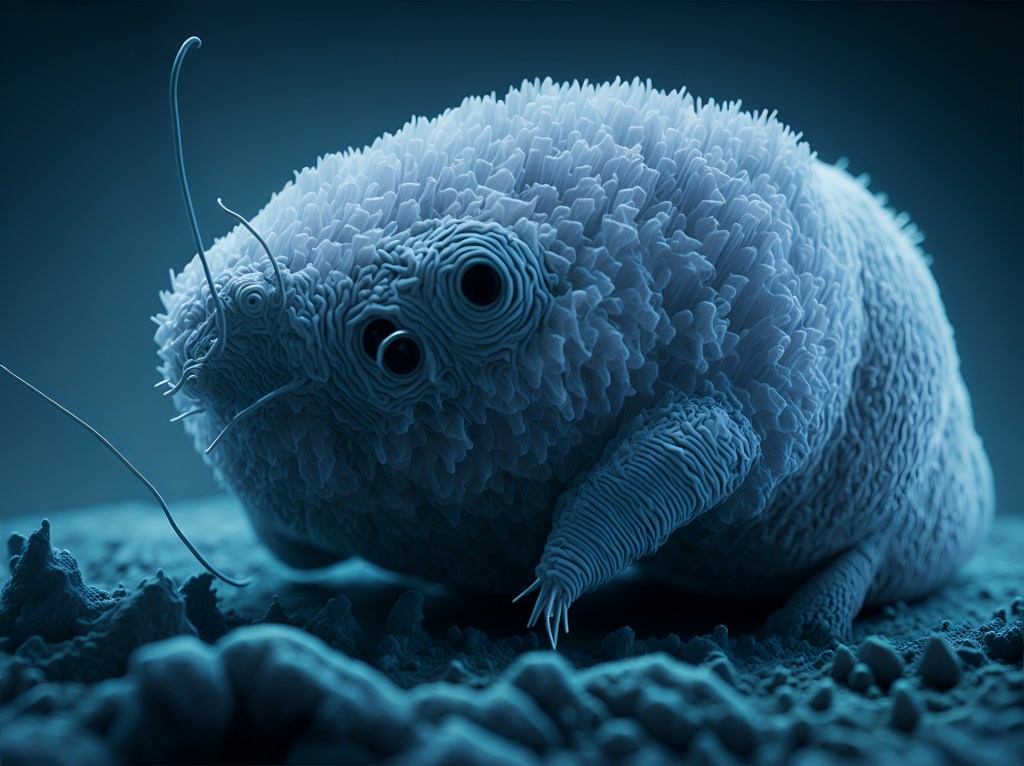
Mary Jo Rabe visited the Starfarer’s Cafe this week, coming all the way from Germany. You may recall that is a nation state on Earth, the planet that the Martians tried to vanquish a few centuries ago but failed to conquer thanks to the planet’s microbes. Rabe turns the tale around – what happens when a pair of microbes want to return to Mars?
Kasei and Nirgal slid frantically over the rocks in the abandoned uranium mine in Menzenschwand. They were hungry. It was time for the microbes to eat breakfast, time for them to absorb some energy from the nanoparticles of radioactive dust on the rocks.
Kasei said, “I know the uranium dust here is nutritious, but I’m getting tired of only having this bland stuff to eat.” Kasei liked to complain, even about things that were his own fault.
Nirgal said, “Everything in this mine tastes bland. Mars had much more diversity of taste, both on the surface and underground. You were the one who wanted to find out what food on other planets tasted like. You decided it would be fastest if we went to the closest planet. That’s how you talked me into hitching a ride on the flying debris when the next asteroid scratched the surface of Mars.”
“Yeah, yeah,” Kasei admitted. “My bad. A billion years later, we’re still here. We floated around this third planet from the star more times than I can count and feasted on all the dusty rocks we could find, which wasn’t always easy. None of them tasted that great, and the ones without much radiation left us hungry.”
“You’re right about that,” Nirgal said. Nirgal was amazingly patient for a microbe, and for that reason was the only real friend Kasei had in the Martian microbe community. “This planet is no place for gourmet microbes like us.”
“I couldn’t have known that before,” Kasei said. “The worst thing is that a lot of promising rocks here are infested with organic garbage. I’m grateful that the huge native creatures closed this mine so long ago. We’ve been able to enjoy this clean food here without being disturbed. It’s bland but not contaminated with organic scum.”
Both microbes stretched their sturdy, toughened membranes to the limits, reducing their thickness to the nano level. After absorbing the maximum level energy possible, they fell asleep, remaining mentally connected with each other as usual.
Their discontent continued to torment them once they woke.
“I hate to admit it,” Kasei said. “But after a billion years I am starting to miss the connection with the microbe group mind back on Mars. Together all of us did come up with more ideas than just the two of us. Too bad transmissions from the group mind don’t reach as far as the next closest planet.”
“Do I need to remind you that one reason we left the planet was because you said the rest of the microbes annoyed you?” Nirgal asked. “We have no idea how the microbe group mind on Mars might have changed since we left. Remember, there was some worry about the planet losing its atmosphere and the microbes having to flee underground.”
“Still,” Kasei said, “I think I want to go back. What about you?”
“Fine with me,” Nirgal said. “I like to travel, and I’m getting tired of this place too. Still, going back to Mars won’t be as easy as coming here. We can’t count on hitching a ride when the next natural piece of space debris crash lands on earth and bounces some material back into space.”
“You’re right,” Kasei said. “So, we’ll have to get the life forms here to transport us back.”
“Then we’ll have to do some serious telepathic brainwashing,” Nirgal said. “And that requires more energy than just listening to their brain activity. It might even require more energy than we can ever store. Two microbes just don’t have the same power as the entire community on Mars.”
“It could be doable,” Kasei objected. “Plenty of the intelligent creatures on this planet already want to travel to Mars. We just have to make them a little more insistent, and we have to make sure we get to the location that any travel to Mars will leave from whenever it does leave.”
“Traveling and influencing the local creatures ─ that all takes energy,” Nirgal said. “Uranium dust is a wonderfully efficient source of energy for us. So for our trip to any launch center, we have to make sure we can feast on enough uranium supplies along the way.”
“That’s why we taught ourselves to sniff out uranium,” Kasei said. “We should be able to find enough along the way. Anyway, I think we should get started.”
“Okay,” Nirgal said. “I’m in. First, let’s see if our telepathic powers are up to researching the most likely location for a rocket to Mars to leave from. Then we’ll have a large lunch and afternoon nap. After that we should be energized enough for the first leg of the trip.”
“It’s also never too soon to start sending out telepathic waves of longing for the planet Mars. It would be good for as many people as possible to pick up on that.”
After their restorative nap, the two microbes slipped through a crack in the mountain around the mine and floated on top of a pleasant breeze down to the train station in Seebrugg. This was where the uranium had been stored before it was transported by train back when the mine was in active use. There was still enough uranium dust around the tracks for Kasei and Nirgal to tank up energy with.
They sent out waves of heartfelt longing for Mars to creatures on the tourist ship on Lake Schluchsee for practice, noted the success of their influence on the passengers, and then proceeded to cling onto the roof of a bus downhill all the way to Waldshut on the Rhine River.
From Waldshut they floated on a breeze across the Rhine River over to the nuclear power plant in Leibstadt, Switzerland. The uranium there was of the highest quality, and they spent an extra week enjoying their spa resort. “I almost hate to leave here,” Nirgal admitted. “We shouldn’t have wasted so many years in Menzenschwand.”
“It’s always hard to leave one place that’s good enough in the hopes of finding some place even better,” Kasei said. “That’s why we need to get back to Mars. We’re getting soft here. We need more intense challenges.”
They continued on their way. From Leibstadt they enjoyed riding on the top of several buses, eventually arriving at the Zürich airport.
“Where to now?” Nirgal asked.
“My research indicates that most flights to Mars will leave from Cape Canaveral, Florida,” Kasei said. “So we increase our chances of hitching a ride by hanging out there. There is also a suitable nuclear power plant about an hour down the road from there via ground transportation, the St. Lucie nuclear power plant on Hutchinson Island.”
“Okay, let’s go there,” Nirgal said.
In the airport, they then looked for a suitable flight to Orlando, Florida. The one with Icelandic Air stopping only in Iceland looked promising. Above a certain elevation, the cosmic radiation would keep them sufficiently energized. Having ridden on a rock from Mars to Earth, they knew their adhesive talents would keep them safely attached to the outside of the plane.
The flight from Zürich to Reykjavik was uneventful except for the tasty volcanic dust they encountered before landing at the Keflavik International Airport.
“This radon is really good stuff,” Nirgal said. “Let’s stay a while. Hard to believe, in a billion years we never made it to this volcanic island. We don’t want to miss out on anything before we go back.”
“Okay,” Kasei said. “There isn’t any flight to Mars scheduled for the near future, anyway.”
Iceland turned out to be a welcome vacation site. They took several trips to volcanoes and geysers. The radiation levels in the volcanoes were sufficiently high, and the dust around the geysers was sparkly clean and warm, and sported a unique taste.
After this somewhat lengthy detour, Kasei and Nirgal continued their journey to the Orlando airport. It was a long flight. They arrived tired, cold, and a little hungry. Cosmic rays weren’t as satisfying a meal as uranium dust. They immediately hitched several rides to get them to the St. Lucie nuclear power plant.
It was a little complicated to get into contact with the uranium there, and took longer than they had assumed. They were completely exhausted and ravenous when they could finally stretch out and absorb some needed energy. The uranium dust didn’t taste as good as what they had had in Leibstadt, but they were beyond caring.
Nirgal especially missed the Swiss cuisine. However, energized enough, they both sent off more telepathic messages to get people to demand more rockets to Mars. Then they hitched their way back to Cape Canaveral.
The telepathic eavesdropping they did in an attempt to find out when the next flights to Mars could be expected was especially fatiguing. They had to take frequent breaks and hitch their way back to St. Lucie to refuel.
“This is stupid,” Kasei said. “They have one good project after another planned, and then some idiots cut their funding.”
“Well,” Nirgal asked, “Should we try our luck at some other launch site instead?”
“No,” Kasei grumbled. “For the moment the chances are still better here.”
Their research finally came up with something promising, a mission with plans for a vehicle to land on the planet Mars, send robots down to the bottom of the Valles Marineris to blast a deep hole another seven kilometers down into the planet, making it possible to check out the interior of Mars.
“Perfect for us,” Kasei said. “In case our fellow microbes have fled underground, we’ll have an easier time finding them. Now all we have to do is make sure that we are here when the rocket to Mars launches.”
“Hmm,” Nirgal said. “Well, then we still have some time to investigate everything. There was something that bothered me, but I can’t remember what it was. Maybe I have to get something to eat first. Back to St. Lucie?”
Mary Jo Rabe is originally from rural eastern Iowa and earned her first degree from Michigan State University. She worked as a librarian in Germany’s Black Forest for 41 years. She enjoys writing science fiction, modern fantasy, historical fiction, crime, and mystery stories.



 STARFARER'S CAFE