
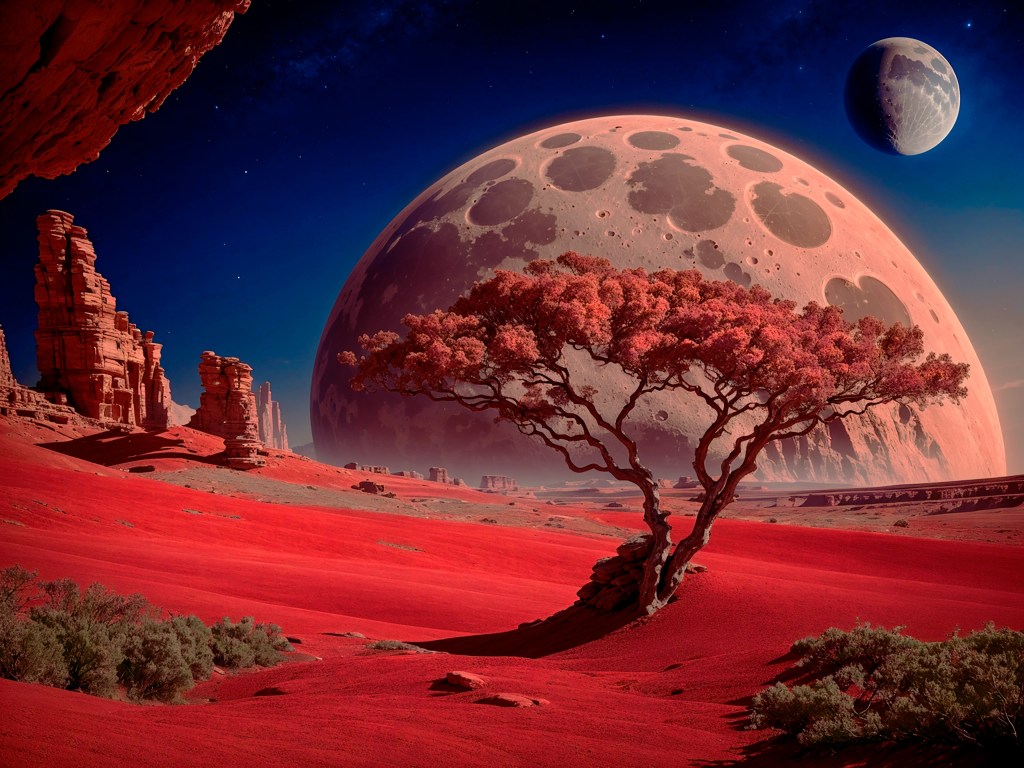
Rob Bignell returned this past week to Starfarer’s Cafe with the tale of a strange man marooned for years on a desert world. Perhaps being alone for so long has psychologically warped the castaway … or perhaps he simply has become more human – er, humane – than his would-be rescuers?
The streak of light arced across the sky as if a falling star when suddenly, to Tiassale’s surprise, it leveled and flew straight toward him.
“Men!” he slurred, “after all these years, it’s men!” An icy shiver ran through him, and he pulled back into the crevice of the rock outcropping, stared at the brilliant glow. Miles of salt flats, a dry bed of crimson and pastel green, separated them. Then the light disappeared.
Tiassale did not move, remained frozen like a mandar before it struck the baeddan, refused to even itch his peeling nose. A strong gust blew sand up from a valley behind the basin ridge, and he decided the craft had landed. It’s best not to move, he told himself, they might very well be Dorjan’s men – maybe even Dorjan himself – returning to finally finish his business. From that distance, Tiassale couldn’t make out the ship’s silhouette. Not that it mattered anyway; if the craft was human, Tiassale wouldn’t have known, he’d been marooned so long.
For hours nothing happened, yet he remained still. Dorjan’s men had scanners that could detect movement even as subtle as breathing. He only hoped his clothes, layered in dust caked by years of sweat soaking through the fabric, would hide the slight rise and fall of his chest, just as sand concealed the stonebats of 82 Eridani, that cursed world where the struggle between he and Dorjan had begun.
Then, as the sun’s gold cast fell directly upon him, he spotted three humanoid figures crawling down an ancient draw in the basin ridge. They paused at the bottom, drank deeply from their canteens before setting off across the saltscape. Waves of heat trembled upon the cracked plain.
He whimpered. Isn’t this what I’ve been waiting for all these years, Tiassale asked himself. He thought of his duties as garden keeper, wondered who would care for the mandar if he left. The reed flute beneath his clothing dug into the skin, and the nose itch had migrated to his sun-blistered forehead, but still he did not move, would not until certain the humanoids weren’t a mirage. Yes, that’s what they are, he told himself, a mirage, a test of my resolve, of my worthiness.
The three figures jumped back as a thin kaida lizard scampered past on two legs across the blistering salt, the frill encircling its neck erect with fear. The kaida usually unfurled its throat skin to catch brine flies or lure a mate, but Tiassale supposed they had startled this one as it lay crouched in a depression. Then one of the figures tried chasing the kaida but was too slow; the other two joined him as they sought to corral the reptiloid, which running full tilt barely came up to their ankles. It is no mirage, Tiassale told himself. They behave like men.
Once the kaida eluded them, the figures laughed, their cackling echoing across the basin. The shortest bent over, placed his hands upon knees as the other two drew long draughts from their canteens. No, I must be dreaming this, he nearly said aloud, the heat would burn through their boots as they stood upon the salt flat. Perhaps it’s not a test, after all, but a dream.
At last the three figures continued marching toward him, but their heads drooped as they swiped arm sleeves against brows. The men did not act like hunters or soldiers who delighted in the search, Tiassale thought; certainly crossing such an open plain would not offer the advantage of surprise. Still, he refused to move, only watched their shadows lengthen as their dragging feet cut a trail like a jagged scar upon the salt flats.
Should I hide, Tiassale wondered. Flee? Greet them? How can I ever tell them … how can I tell them something I myself am not sure of?
Finally the three figures reached the field of rocks near the outcropping’s base and paused again. Tiassale squinted, did not recognize their faces.
He rushed madly toward them.
***
The three men stared at Tiassale, as he scrambled through the rocks, waving and shouting. His mouth pained from trying to form words, and to him they looked confused, as if unable to understand.
He stopped just short of them. Grimy sweat covered their faces. “You’re men!” he shouted. “You’re men!”
The figure with the most piping on his collar stepped forward. “Are you Crewman Franklin Tiassale?”
He gawked at them. “You’re really men!”
The one who’d first chased the kaida chuckled. His namepatch read CAILEAN.
“Doesn’t matter if he’s Crewman Tiassale or not; after crossing that sand trap, he’s close enough.”
Tiassale’s eye cocked toward him. It’d been so long since anyone had spoken his name that he’d not recognized it at first. He tried remembering how to form the sounds of words, spoke slowly. “Yes, my name is Tiassale.”
The man who’d stepped forward grinned. ‘‘I’m Lt. Tom Delaney, of the S.S. Tilchov. This is Chief Petty Officer Bly and Crewman Cailean. Strange world you’ve got here, Tiassale. Sun rises in the west, sets in the east. And then there’s that lizard we saw.”
“The planets in this system travel retrograde. The lizard is the kaida … it consumes brine flies.”
“Yummy,” Cailean said.
“Come, my camp … is a short walk from here,” Tiassale said as gesturing toward the rocks. “There is shade. You must be hungry.”
The men followed Tiassale across a rock field. With each step, boulders of increasing girth and height rose all around them. As the steep path widened, Delaney walked alongside Tiassale. “I have to admit, we’re surprised to still find you alive.”
“You came for me? Of course you did – why else would you know my name?”
“Star Service would have sent a ship sooner, but investigators discovered only a few weeks ago through one of your crewmates that you hadn’t died but were marooned here. We’re actually on a mission to MW1037, but as our route passed by, we were ordered to conduct a search.”
“An investigation?”
“Apparently some guy named Dorjan got himself into trouble bootlegging on Niyati V. A real discredit to the service.”
Atop the incline, their path opened upon an oasis of white sand and lush, semi-tropical plants. A log sat beside a small pit half full of ash, behind it a thatch lean-to covered with leaves from the oasis’ tall, almost palm-like trees. A Star Service insignia, torn off his uniform, hung over the shelter’s entrance. Tiassale crouched at the pit, picked up what looked to be a turtle shell. The faint, shrimp-like scent of grilled jarah wafted about the encampment.
“How’d you survive out here?” Delaney said.
“There’s a spring nearby. I’ve also started a garden. It is crude … but sustains me.”
Delaney kneeled across from him, examined a round chip of hardened salt at their feet. “A garden?” he said as reaching for the chip. “There’s hardly any water here.”
Tiassale’s hand clasped Delaney’s fingers as they gripped the salt piece. “I’ve learned not to overturn rocks.”
Delaney considered Tiassale’s hand, and he cautiously released the stone. “Is something dangerous under there?”
Tiassale nodded and slowly lifted the rock. A slug-like creature no larger than a thumb squirmed into the sand. “I call it a jarah. It lives in burrows under rocks where the shade shields it from the heat. They’re quite good to eat. Kick too many rocks, though, and they die. And then you starve.”
Delaney grimaced. “You eat that?”
“It is one of this world’s many delights.”
***
As the moon’s silver light rippled across the pool, Tiassale drew items from the toiletry pack the Tilchov men had left as promising to return in the morning. There was soap, shampoo and a razor, a packet of shaving cream, a microthin hand towel and mouthwash. He unscrewed the antiseptic’s cap, brought the bottle to his lips and swigged. The wash burned his mouth, and he spat it out. Dumping the remaining items onto the sand, Tiassale picked up a comb and for the first time in years ran one through his rumpled hair. It struck a snarl, and he winced as disentangling it. Wet it first, he told himself, and he leaned toward the water.
Tiassale stopped, gazed at his dim reflection. It had been the only human face he’d seen for eight years. During the day, he’d sometimes stare at that reflection for hours; it was one of the few things that had kept him sane. At night, he’d gaze into the inky sky, hoping to spot a starcraft, desperately wishing one might enter orbit though he possessed no means to signal it. To pass the time, he created constellations of the creatures and plants seen in his oasis, developed tales around the star groupings to explain how they came about in this world. Soon, he grew use to the peacefulness of his desert, devoid of a modern, spacefaring civilization’s noise. And then there was the fruit of the Mandar, the manna that brought him peace.
Yes, ask the Mandar what to do, he thought, they have never lied to you.
He rose from the pool, leaving the toiletries pack and its items scattered at the shore. Fronds blocked the stars and moonlight as he slipped between the trunks toward the escarpment valley where the Mandar lived. The insectoids’ chorus rose, as he approached the oasis.
Tiassale kneeled, picked up a Mandar fruit lying in the pebbles of what once had been a streambed. He bit into it, and the fruit’s liquid, tasting vaguely of fermented grapes, washed about his mouth. Almost subconsciously, his hand brought the reed flute to his lips. His tune sounded prayerful, gentle. Under the moonlight, the Mandar rose from the crevice, their tree-like trunks growing erect, their branches entangled with one another.
They swayed to his song. The memories of Kira, the girl who’d spurned him, the anger that led to his joining the Star Service so he could flee light years from her, the great emptiness between the stars that gave him time to think of only her, the camaraderie he had hoped to find but didn’t on the ship he joined, the fear of Dorjan bullying him – it all fell away from his mind like a heavy, overstuffed kitbag suddenly dropped from his back. He stopped playing and gazed at the Mandar.
Their thoughts began to enter his head.
***
Captain Renate smiled, heartily shook Tiassale’s hand. “It’ll take six months before we get back to Earth,” Renate told him as they stood at the salt flat’s edge, “but you’ll be getting back. We’ll need to conduct a physical before bringing you aboard – it’s regulations, that’s all.”
Tiassale nodded, gazed absently at the distant wind-carved rock. The rest of the landing team, though genial, stood back from him as if disgusted by his stink; he’d grown used to it and until that moment hadn’t thought about it in years.
One of Renate’s men chipped a slice of the salt crust off flats, looked at the underside streaked with a blue-green ribbon. “Algae,” he said, holding it up for others to see.
Another crewman stood with hands on hips, sweat glistening across his face. “High levels of halite, barite, gypsum … we may be looking at Earth’s future when the oceans start evaporating off, in say 500 million years.”
The man who’d chipped off the salt crust glanced up. “That’s what I like about you, Slade – always the optimist.”
Captain Renate and his crewmen grinned.
“The sun,” Tiassale sputtered, and then he paused; it’d been so long since he’d spoken aloud, and so he went slowly, thoughtfully. “The sun in this system is much older than ours.”
Renate slapped Tiassale on the back. “Your report to Star Service on this planet will prove invaluable. You probably know more about it than a science team could after spending a year here with the most advanced survey equipment.”
Tiassale smiled, wished Captain Renate had been in command of his first ship. The horrible things Dorjan had done wouldn’t have been allowed.
“What about it, Cap?” the crewman with the salt crust said. “It’s not such a bad little planet – maybe a little dry, but nothing our Star Service engineers couldn’t solve in a few weeks with wells and irrigation. Send a report to base noting the lack of sentient life?”
Captain Renate gazed at the horizon. “Those red rocks rising against that blue sky certainly are beautiful. But there’s no point colonizing a planet where the oceans are evaporating.”
“Yeah, you’re right,” the crewman said. “Used to be a nice star, though. Too bad it’s turning into a red giant.”
“Suppose we could give it a name, however. What about it, Tiassale? Any idea what we should call this rock? Hey, Tiassale!”
Captain Renate and the survey team gazed at Tiassale. He stood silently, staring at the brilliant shine of their boots.
***
Slade and Orford followed Tiassale through his camp as he showed them the bones he’d converted into implements and the turtle-like shell used for a bowl. “And these are the rocks I shaped into mortar and pestle,” he said, holding them up proudly. “You can’t imagine how long it took to make them.”
The Tilchov’s two crewmen faked smiles of interest. “But what did you eat?” Orford said. “Besides those rock worms?”
“I can freely eat of every tree in the oasis. The dormant snails near the water’s edge are edible; you can just put the shell into your mouth and suck out the mollusk. The tamara’s hard-shelled fruit provides milk, and its dried seeds can be pounded into a flour for bread.”
“You must miss Earth foods – chocolate, caramel … beer,” Orford said.
Tiassale tried to ignore the stirring in his mouth. “Have you seen my shelter? I weaved thatch from the thornbrush to create stronger walls; it’s mainly a sun shield for daytime, as most of my waking hours are at night.”
“At night?” Slade said. “Why’s that?”
Tiassale glanced oddly at him.
Orford ribbed his crewmate. “Because it’s cooler then, you dummy.”
“Of course, right. So what else have you got around here, Tiassale?” He started down the trail along the streambed.
Teasdale lips trembled at their corners. “There is nothing back there to see.”
Slade and Orford eyed him. “Then you won’t mind us walking around it, either,” Slade said.
Tiassale quick pointed through the oasis trees. “There’s just alida castles.” A half dozen pillars shined red in the harsh sunlight. He headed toward them, and the Tilchov’s two crewmen followed. An array of crusty red mounds, the alida’s hives, spread out before them on the saltscape. Tiassale walked up to one, pulled from his pocket a twig and gently inserted it into a small hole on the mound. He withdrew it, held it up for Slade and Orford to see.
Tiny insectoids scurried across the twig.
“The alida eat the speargrass and use their dung to glue together the particles of earth that make their home. The kaida lizards eat the alida.”
“And let me guess – you eat the lizards?” Orford said.
“Yes, but like the kaidas, I also eat the alida,” Tiassale said. He placed the twig in his mouth, swallowed the insectoids that his tongue swept off the wood. “They’re quite plentiful.”
Slade grimaced, and Orford turned away, kicked the bottom of the mound, splitting it open. Alida tumbled out, crawling over every inch of exposed earth. “There’s certainly a lot of them in there.”
Tiassale face paled as he stared at the upturned red soil; the Tilchov crewman was no better than the baeddan. “Why did you do that?”
“Do what? You mean kick the mound?”
“You’ve created a hole for the kaida to enter.”
“Isn’t that how the lizard catches those things? By digging into it?”
“But now it doesn’t have to. And your hole is much larger than the lizard ever could make. The kaidas will feast.”
“So?”
“Plentiful food means they’ll breed.”
“Isn’t that what you would want? You eat the lizard, after all.”
“And them,” Slade said, looking at the insectoids.
“More kaidas means fewer alida,” Tiassale said. “Eventually the kaidas will run out of food and starve. Then there will not be enough of them to eat for years.”
Orford rolled his eyes. “What do you care? You’re getting off this salt ball in another day or two.”
The Tilchov’s two crewmen walked back toward the campfire. Tiassale’s eyes narrowed. They’re planning something, he thought. Perhaps they are raising my hopes only to abandon me again, to finish the job of driving me mad.
***
Tiassale stared at the night sky above his oasis. He recalled his first days on the planet, when he’d filled the lonely hours by naming the oasis’ creatures, searching for shapes in rock formations, creating constellations and the tales to explain them. As the days passed into weeks, the weeks into months, the months into years, he came to believe the distances between the stars sheltered him from Dorjan. The fools thought they’d abandoned me in a hell to perish, but this was paradise, Tiassale told himself as he laughed. He thought of the distant range’s changing moods as the sun crossed the sky, of the firm and juicy taste of the jarah, of the tamara blossom on the breeze, it reminiscent of frankincense tears, the warmth of this sun against his cheek as evening approached, the song of the gita turtle – he’d carved a reed to make a flute of sorts and had learned to imitate it then play along and improvise melodies around its strain. If he left, they would be reduced to memory. Would he forget them as he had so many things of Earth when he fled into space?
A brilliant dot, the orbiting craft, moved swiftly through the starfield overhead. As Tiassale’s hope of being rescued waned during those first weeks of being marooned, he thought he might go mad. One night, when a bright moving light across the night sky turned out to be a comet and not a starcraft, he decided to end it all. With reed flute at his lips, he played a mournful song, told himself he would keep playing as walking past the alida castles into the saltscape, where the sun, once it had fully ascended above the horizon and heated the sand and air, would kill him in minutes.
But as he neared the streambed, shadows rose over the dim ground. His eyes followed them to their source – a cluster of strange tree-like plants climbing from the crevice, swaying to the melody of his song. The reed fell from his lips, and as he swallowed hard his numb fingers dropped the instrument to the sand.
After a moment, one of the branches leaned forward, pushed a small round fruit toward him. During all the time he’d been marooned, the complex of hanging branches in the crevice with their small nail-like ends merely looked to be some shrub that clung in the fissure, likely where pooling water and the rock shade would protect it from the sun’s hot brilliance. He’d never once seen it move of its own accord. Perhaps I’ve already gone mad, he thought.
The round fruit stopped just before his feet, and he kneeled to examine it. The fruit was perfectly spherical, like an orange, but its skin shined with the color of a ripe crimson apple. He placed the flute back in his pocket, sniffed the fruit. The branches, now high above the crevice, wavered.
They responded to the music, offered me their fruit. Was it a thanks, a gift of appreciation? Though he no longer played the flute, they remained exposed to him, and he wondered if they were waiting for him to pick up the fruit. Yes, that’s it, he told himself, they’re waiting for me to eat it, to show them that I am grateful for their gift. He bit into it.
The fruit tasted sweet, like a succulent green grape. Some of the juice ran down his hand as he took another bite. And then he suddenly felt dazed, as if warm and near sleep.
He heard the branches’ thoughts.
Tiassale realized he had it all wrong. The branches weren’t thanking him, they were trying to communicate.
They were awaiting his question.
He thought, Question?
“Yes. Your inquiry. When you sing the melody, we are available to answer your question.”
It spoke not aloud, but in my head, not through language but in images.
I wasn’t singing.
“Did you not repeat the gita turtle’s melody?”
Yes. But I played it, on my instrument.
He felt their puzzlement. “You are not a creator, are you?”
A creator?
“The ones who made us.”
There are others here? Others like me?
“No. There have not been here for many millennia, not since the sun began expanding.”
Are you alive? Or machines?
“We are alive. Our genetic makeup is such that we store information for the creators. That is why we exist – to answer their questions.”
What questions?
“Why any question at all about anything, but mainly the city. You are at its entrance.”
City? What city? There is no city.
A sense of deep, overwhelming sadness swept through him. “Yes. We know.”
***
He spent many hours each day with the Mandar, hoping he was not insane. But he soon grew to doubt that; the Mandar told him far too many things that he never could have figured out on his own, things that were necessary to his survival. A race technologically superior race to mankind had created the Mandar, he soon learned. With hyped-up photosynthesis in leaves permanently green, oval and glossy, the sun supplied the Mandar with power; within their cells were neurons that allowed the superplant to store knowledge and share it telekinetically with the creators. To ask a question, all one had to do was enjoy its profuse fruit, which temporarily rearranged the brain waves in a section of the creator’s brain. The Mandar were not slaves but librarians of knowledge, guides for the creators going about their business.
But the creators had gained sentience only a hundred millennia before their main sequence star began to bloat into a red giant. Realizing the calamity about to befall them, they abandoned their world for another star system. Tiassale did not fully understand, but a trait in the Mandar’s genetic makeup disallowed their easy transplantation. So the creators simply left them behind.
Many Mandar perished down the ages as the star’s core grew hotter and the outer shell expanded. The oceans about them evaporated, the flora withered in the blistering drought, the creators’ buildings turned to dust. Soon there would be nothing – and these Mandar, likely the very last of their kind, realized it.
***
At sunset, dust devils danced across the plain as the air about Tiassale’s camp cooled. He barbecued jarah over a fire for the Tilchov men, and as the meat sizzled a spicy aroma arose from the skewers.
“You should hear some of the broadband transmissions we’ve recorded from worlds we’ve passed by – the ones without space travel,” Cailean said. “Man, can some of them ever wail. And the sights to see in the galaxy! There are Vega’s dust rings and TW Hydrae’s protoplanetary disk, this vast swath of pebbles extending more than a billion miles out from the sun – it’s just ripe for mining.”
Orford nodded heartily. “You’re going to love getting off this ball of salt.”
Tiassale remained quiet as he sat beside the fire; he stirred the ashes and found coals that later could be used to start a new flame. The desert world got cold at night.
“Do you think there was once was an alien civilization here?” Delaney said.
Tiassale’s eyes looked up, as if startled, then he gazed at the fire pit and shook his head. “I’ve seen nothing indicating so.”
“There aren’t any surface signs of a civilization,” Delaney said, “but this star has been in its red giant phase for almost half a billion years. That’s long enough for any remains to be destroyed or concealed.”
Tiassale ran a hand through his hair, realized it was greasy compared to the Star Service men, and suppressed a grimace. “I’ve never seen any such signs. It’s just me, the Kaida, and a few palms.”
“It’s a big planet.” Delaney said.
“Hey, are those rock worms of yours just about done?” Orford said. “I’m getting hungry.”
Tiassale held up a hand for him to be patient.
“If we did find any signs, it’d be quite a quick archeological dig,” Cailean said. “I don’t think the captain would let any of us stay behind.”
Delaney nodded. “We’d have to excavate en masse and take them aboard the Tilchov.”
Tiassale’s eyes flew up. “Why not just send a science team here?”
The Tilchov men laughed. “This world is a long way out, Tiassale,” Delaney said. “When’s the last time you saw a starcraft pass this way?”
Tiassale’s thoughts scrambled, but a lone one emerged from the panicked noise in his head: After all the Mandar have done for me, they must survive. Tiassale composed himself, knew he couldn’t let them on to the Mandar. He pulled a skewer from the fire, offered the jarah to the Tilchov men.
Delaney pulled a jarah from the stick. “I can’t believe you talked me into this,” he said, then plopped it in his mouth. After a couple of bites, his nose wrinkled and gagging he spit it out. Cailean and Orford rolled in laughter.
“Damn, Tiassale,” Delaney said, “are you trying to poison us?” He wiped at his mouth with the back of his hand. “I ought to do you a favor and start turning over rocks.”
***
Their thrashing awoke him. He sat up in his thatch lean-to, rubbed his eyes. Heat waves simmered across the plain below. The whip-like sound of a branch against raw skin sounded from the streambed, and a yelp instantly followed.
Tiassale ran toward the Mandar, knew a baeddan was attacking. The pig-like creature with horns jutting alongside its snout often dug for tubers that grew near springs, but it had also developed a taste for roots. Though capable of defending themselves against a single baeddan, if a band attacked the Mandar soon would find themselves overwhelmed and weakened with each dug-up, eaten root.
At the crevice, a baeddan scratched hurriedly at the Mandars’ far edge, barely within their reach. It backed up each time their branches swatted then quick rummaged again during the reload. Ribs stuck out along the baeddan’s thin sides.
A Mandar branch curled toward Tiassale, as he entered the clearing, rolled a fruit toward him. A call for help or an involuntary response to my presence, he wondered.
No matter which, he had no need of the fruit to know what must be done. If the baeddan was not stopped, the Mandar would die, and he would perish from insanity.
Tiassale screamed at the baeddan, ran straight at it. The boar’s nictating eyes flew wide open, and it darted out of the way. But as Tiassale rushed once more, the creature ran in a half-circle toward the Mandars’ other side. Tiassale and the creature stared at one another, a man pushed from his green world by the cruelty of others, the native beast driven from his lush woods by a bloating red star. And now both had come to this streambed, needing the same patch of plant to survive.
The baeddan, keeping its eyes upon Tiassale, scratched once more at the crevice wall. Dry clumps of sand tumbled to its bottom.
Tiassale let go a mighty roar and leaped at the baeddan. It shot back, and as arching toward the opposite side, Tiassale switched his angle of descent. His shoulder slammed into the baeddan’s ribs, and the alien beast rolled. Tiassale, a mad fury in his eyes, thrust his arms at the baeddan, grabbed its neck. The baeddan squealed, tried to turn its head to bite Tiassale’s wrist, but his hands only tightened their grip. He swung his legs over the baeddan’s back and holding the creature down coursed his full strength into the hands and snapped its neck. The baeddan let go a gasp as its tongue hung limp from the mouth. The creature’s dead weight slumped to the sand.
For a long moment, Tiassale did not move, only let himself catch his breath. He’d saved the Mandar and so had saved himself. Letting go of the throat, the baeddan’s head thudded against the ground, and rising he wiped the grit from his hands.
The Mandar rolled another fruit to him.
He picked up the crimson sphere, bit into it. The fruit’s sweet juices swathed the inside of his dry mouth, dribbled downed his fingers. He swooned.
They were awaiting his question.
***
The Tilchov’s doctor applied analgesic to the blisters on Tiassale’s forehead. “I’m surprised these aren’t infected,” the doctor said.
“I rub tamara juice on them. It blocks dangerous bacteria and toxins.”
“Oh? How did you learn about their properties?”
Tiassale wanted to say through the Mandar. They knew the answers to all problems, it seemed. Half sentient, they appeared to thrive on answering questions as much as on sunlight. That was all right. He needed companionship.
“By accident,” Tiassale said to the doctor. “I spilled some on myself once.”
“Hmm. Most good discoveries are by accident. I’ll have to take a look at this tamara juice; it appears to work better that the topical pain relievers we have.” The doctor pulled a pair of new boots and a Star Service uniform from his case. “And this is for you. The computer used our scanner recordings of you to determine the measurements.”
Tiassale’s lip curled. “I don’t want them.”
The doctor’s brown rose. “Certainly you don’t want to stay in those … clothes.”
Tiassale glanced down at his dust-caked tunic. “What’s wrong with them?”
The doctor grimaced. “Well, for one thing, they stink.”
Tiassale’s eyes slowly widened. He was among humans again, and that meant what others thought was important, even if it sometimes cancelled one’s own beliefs.
The Mandar did not judge, merely answered questions, and he’d grown used to that. Yet, he still found himself during the years trying to please them, to thank them for their company; he became their gardener, building shallow ditches that brought water to their roots, setting traps to keep the baeddans at bay. Their only response was to answer his questions when he wondered over the details of such projects.
He glanced at the doctor’s dusty boots, then at his own. The dye was virtually worn off the leather, and a long crack ran along one seam.
“Say, how did you come up with names for all these plants and creatures?” the doctor said as placing his instruments back into their case slots.
The Mandar had told him what they were called. He had made up the constellations and renamed the stars he didn’t know, but the plants and animals, those names were ancient, from an age before Earth even had life. “I’ve had a lot of time to do nothing else,” he said.
Renate’s footfalls sounded upon the rocky trail as he approached. “Good morning, Tiassale. Doctor.”
“Our castaway checks out all right, sir,” the doctor said.
“That’s good news. You should begin packing, Tiassale; the Tilchov departs at planetary dusk.”
Tiassale fidgeted. “I’ve been thinking, Captain – sir. Maybe you could pick me up on your way back.”
Renate shook his head. “We’re returning by a different route. There’s a colony 20 light years from here that has shipments we need to collect. We won’t be able to make a detour.”
The doctor stared at Tiassale. “Why would you want to stay here anyway?”
Tiassale shrugged. “I just thought …” A long list ran through his head – he had to make sure the kaida didn’t gorge on the alida mound until the insectoids had a chance to repair it, had to make sure the irrigation furrows to the Mandar were clear of fronds and debris. They will not understand, he thought; they are just men, after all.
“You ‘just thought’ what?” the doctor said.
Renate slapped Tiassale on the back. “Don’t tell me you’re getting sentimental about this ball of salt, now!”
Tiassale’s head drooped. “No, of course not,” he said slowly. “I best return to my camp, see if there’s anything I want to bring.”
“That’s more like it,” Renate said. “Be back here at 1800 local time for departure.”
For a moment, Tiassale paused. It’d been so long since he’d needed to know the exact hour or minute; sunrise and sunset had sufficed all of these years. “I … I don’t have a watch.”
“There’s one in that uniform’s wristband,” Renate said. “You’ll want to wear it – it’ll protect you better out on the salt flats. We’ve made some design improvements since you were last issued one.”
Tiassale nodded, and with uniform tucked under an arm, headed slowly up the trail to his camp. The world spun around him, and he could no longer feel his footfalls as they struck the hard earth. He paused for a moment, hoping the spinning would stop. The doctor and Captain Renate spoke softly. Shifting behind a boulder to the trail’s side, he breathed shallowly so to hear better; bracing himself against the rock seemed to reduce his dizziness. Are the Mandar warning me thanks to some lingering effect of their fruit?
The doctor was shaking his head. “There’s something incredibly odd about him.”
“Of course there is, Doc,” Renate said. “He’s been stuck all alone on a desolate planet for eight years.”
“That’s just it. I reviewed the medical literature on humans who’ve been marooned on planets. He doesn’t show enough psychological let alone physical trauma.”
Renate grinned. “Everybody’s different, Doc. Besides, he’s Star Service, has gone through rigorous training.”
The doctor raised an eyebrow. “A man should mentally break down after that length of time, even with training.”
“Well, I admit he’s a little strange.”
“No – I mean he should be mad. The fact is he closely matches the profile of someone who’s been marooned with another person.”
Renate’s jaw firmed. “Why wouldn’t he tell us about somebody else being here?”
“I don’t know.”
“Could the other one have died? Been murdered?”
The doctor folded his arms. “Possibly.”
“Let’s get some answers – before we bring him aboard.”
***
Tiassale scrambled into the boulder field. If he could elude them long enough, they might eventually give up; they had a schedule to meet, after all. But he’d also have to make sure they knew his route and followed him so none of them would stumble across the Mandar. He swiped sweat away from his forehead, crawled over a set of jagged boulders. They wouldn’t have much trouble picking up his trail if they noticed his footprints.
At the edge of the sharp boulder field he dropped himself into a sandy, alluvial base. He’d have to be careful; craggy rocked filled the stretch between there and the next boulder field, and he could ill afford to twist an ankle. He quickly scampered between the black rocks, focusing on where his feet fell. It was all or nothing now – if they caught him, he’d be forced to tell about the Mandar.
After several minutes, he reached the next group of man-high boulders. Once past the first one, he paused, glanced back. No one was following. He knew that wouldn’t last long, though. By now, they’d scoured his campsite, realized he wasn’t there.
Fortunately, he thought, Slade and that idiot Orford weren’t with the doctor and this shuttle party. They wouldn’t be suspicious of what may lay along the streambed.
He continued on, bracing himself against the boulders as traversing uneven ground.
“Over there!” someone shouted in the distance, and he knew the voice came from where the doctor had examined him. Tiassale quickened his pace.
The boulder field began to climb in elevation, and after a few moments Tiassale stopped to catch his breath. He pressed his back to a rock wall, looked back. A couple of Tilchov crewmen gingerly worked their way through the first set of boulders. At their speed, he’d easily stay ahead of them, so long as he didn’t injure an ankle or knee. One of the Tilchov’s men held a small box in the air, slowly passed it in a half-circle across the horizon. They were looking for his infrared signature. He pressed his back against the rock, eyed the shimmering plain before him, the afternoon heat rippling off it. It possessed a gaunt beauty, he thought. Out there he might be able to hide his heat signature, but they’d be able to visually spot him. I wouldn’t last fifteen minutes upon it anyway, he thought, not even with water. He glanced back at the Tilchov men; they’d reached the stone field.
Tiassale continued on, his face glistening with sweat, hoping his knowledge of the boulder maze would give him an extra advantage. They had hand-held scanners, sensor dust and shuttles, tools he hadn’t needed to survive, though he admitted they made one’s existence more comfortable. But when it came to survival, the tools weren’t the point, really; whether one used a stick to fish alida or a starcraft to colonize new planets, deeper needs and drives underlain all existence. And here, on what he’d had once thought a wretched world, he found a way to live in balance, in harmony – albeit precariously – with those very principles of life itself.
Long shadows began to fall over the boulders as the red sun gradually sunk toward the basin’s ridge. Tiassale had walked for an hour straight then veered toward a mountain spring. He jumped sideways atop a boulder to climb down the other side, believing the trick would confuse the Tilchov men for some time. But as he descended the granite, his sweaty hands slipped on the smooth rock. He slid against the stone face for a second, then landed one foot on a rock half-buried in the ground, as the other foot struck the lower lying sand. He fell, smashed his knee against another large stone. As his forehead bounced on a granite slab, he let go a tiny grunt.
His head turned warm, and he lost consciousness.
***
Captain Renate and Lt. Delaney stood next to the boulder where their quarry’s footprints ended. The prints’ right sides dug deep into the ground, as if Tiassale had suddenly stopped and lurched away.
Delaney scratched his head. “There are no prints up ahead. And I haven’t seen anything in the sky that might have swooped down and got him.”
Renate placed his hands on his hips. “He must have technology of some sort that helped him escape.”
“Like a matter transmitter? No offense, Cap, but that’s pretty far-fetched.”
Renate kneeled, examined the final set of footprints. “No, maybe some device that conceals a doorway or portal.”
“We haven’t detected any infrared signatures indicating the kind of power level needed for a hologram.”
The sky above them purpled as the red sun slipped behind the basin ridge. Renate glanced at the boulder, it looming a good four feet above him. His eye caught a tiny alluvial fan of sand at its base.
Delaney unholstered his plasma pistol. “I’m going to look farther up ahead. Maybe the wind just swept his tracks away.”
Renate rose, shook his head as touching Delaney’s arm. “We need to get back. The Tilchov leaves orbit in another hour.”
“When we return to the shuttle, I’ll deploy sensor dust; we’ve got some aboard–”
Renate pursed his lips. “No, that won’t be necessary. If someone else from his ship were marooned with him, we’d probably have known from the report that sent us here in the first place.”
“Without the sensor dust, Cap, we probably won’t find him.”
“I know.” Renate started back.
Delaney didn’t move. “We’re not going to leave him here?’
Renate looked back at his shuttle pilot. “He doesn’t want to go with us anyway.”
***
Tiassale awoke to total darkness. Throat parched, he gazed at the ground for a while, trying the regain his senses. The cool of night had descended upon him, and shivering he tried to sit up. His head pounded, but not as much as his knee. The insectoids’ buzz filled the air. He felt tenderly along his kneecap then the twisted ankle; nothing appeared broken. Above him, near the comet he called Serna, a twinkling light shot into space’s black depths.
He rose, braced himself against the boulder from which he’d fallen. A slight dizziness overcame him, but the knee and ankle felt strong enough to support him. He began to follow the trail he and the Tilchov men had taken from the oasis. The Mandar will know how to make the pain disappear, he thought. The wind picked up, blowing through his bangs, the hair encrusted with blood from his forehead’s gash. He limped onward.
Behind him, the wind scoured every footprint he’d taken.
Rob Bignell is the author of more than 100 books and the owner/chief editor of Inventing Reality Editing Service. He has been writing science fiction since for the past half-century.

 STARFARER'S CAFE