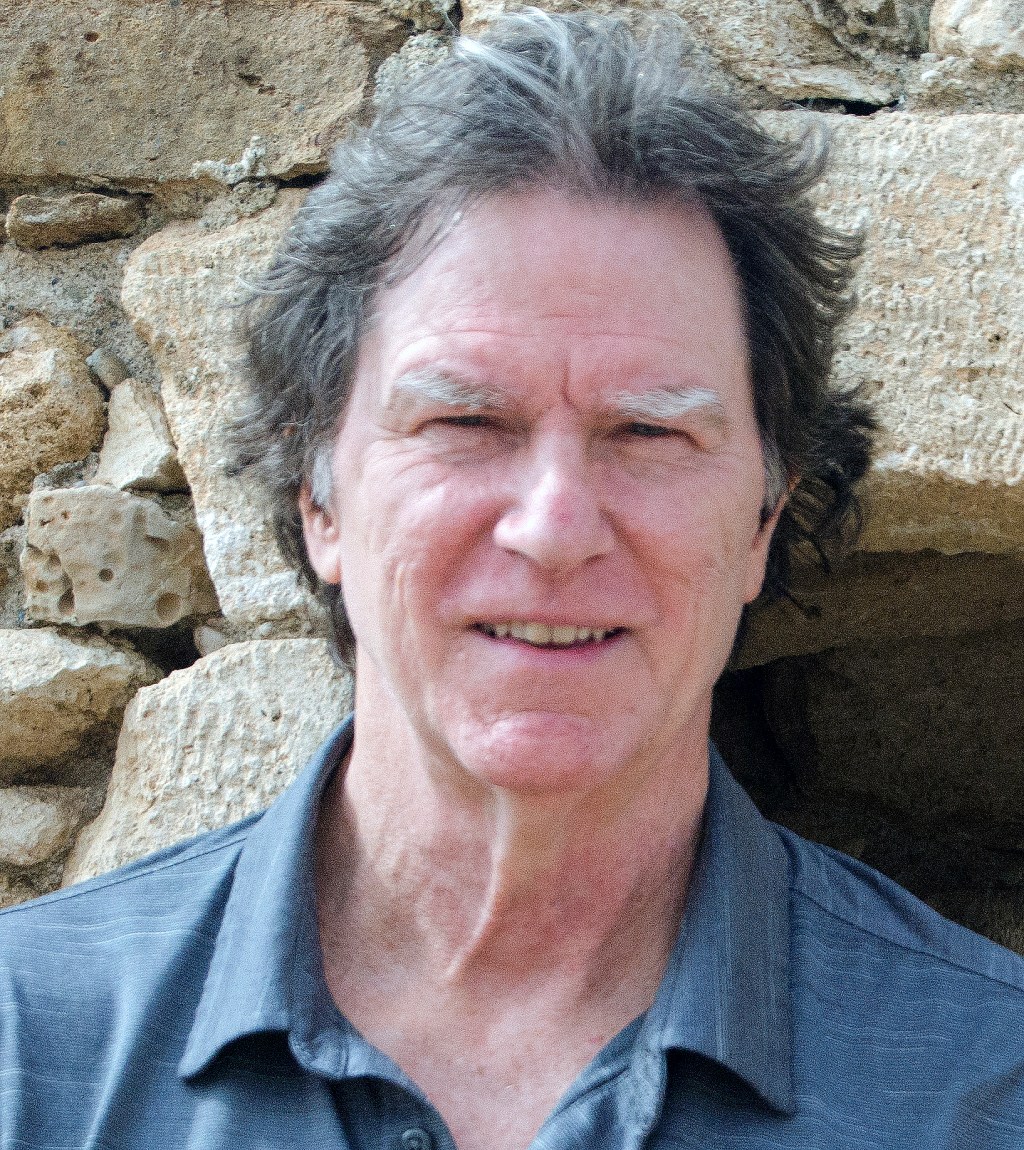
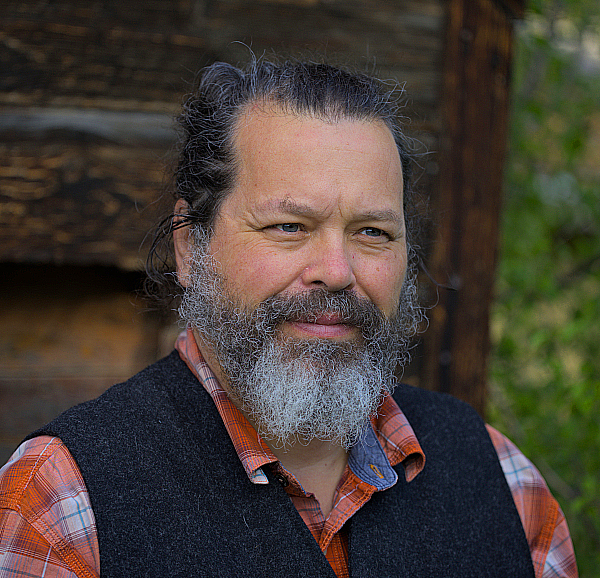
Starfarer’s Cafe recently sat down to talk with science fiction author Dennis M. Kohler, whose short story The Father of Cats recently appeared in our digital magazine. A native of Northern Utah, Dennis lives with his wife Patti, his sons Theodore and Oliver, and three cats -Daisy, Babou, and Lavender. Mostly, Dennis is an optimist. For more about Dennis, please visit his website.
Q: When did you first get interested in science fiction – and then in writing it?
My first memory of reading science fiction was as an elementary child. I would buy old copies of golden age science fiction with dimes at garage sales. I grew up in a small college town where there was a lot of surplus fiction floating around. I think the scraps of story ideas started around the same time in bound notebooks. I didn’t start writing full stories until university, and the business side of it much later.
Q: How do you come up with ideas for your science fiction stories?
I read… a lot. The stories usually come in one of two ways. The first way is playing a game of What if? What if someone discovered x? or What if a child were born to an abandoned colony? The second is what my musical friends call “noodling,” just taking a chord or an idea and rolling it around and moving it until it grows into something that makes sense.
Q: What authors or books (science fiction or otherwise) have influenced your writing the most?
Asimov, Richard Francis Burton, Heinlein, Bertrand Russell, Wittgenstein, and a hundred others.
Q: Science fiction often explores big questions about humanity, technology, and the future. Are there particular themes or messages you hope readers take away from your work?
I have an optimism about how scientific discovery will make human life better, the same way it most often has. With that promise comes the responsibility of using the new knowledge wisely. I hope in every story people see the humanity and how people wrestle with their circumstances.
Q: How important is a knowledge of science, for you personally, when writing science fiction?
I have always loved science, but I am not a scientist. As an undergraduate, I spent some time studying the history and philosophy of science. On the rare occasion when I write hard science fiction, I do believe I owe readers the effort of getting the science right. The caveat is that science is moving very fast. I think I could make an argument that scientific paradigms are being struck down and rebuilt faster now than they ever have in human history.
Q: What is one common science fiction trope that you think is more fantasy than possible science?
I am deeply sad to say it, but it is probably faster than light travel. Along with that comes travel by means other than physical. As a species we need to get off Earth. I remain hopeful that someone, some day, figures it out.
Q: Have you noticed any particular trends in science fiction literature that excite or concern you?
The singularity. The human machine interface. Which I think is on pace to become science reality in my lifetime. We are sitting right on the edge of a massive shift in the way human intelligence can work/compete. That is a fork in the road. Turn one way, apocalypse; the other, utopia.
Q: What’s your favorite science fiction novel?
I have always answered this question since the 1980s, Stranger in a Strange Land by Robert Heinlein, but honestly it is whatever I am reading at the moment. I love what is new to me.
Q: What’s the best piece of writing advice you’ve ever received?
It is probably the same advice I got for doing anything hard and important. If you want to get good at it, you need to do it… a lot. In the words of my friend, the poet Amil Quayle, may he rest in peace, “You need to write a bucket of shit to get a pearl.”
In the early days when nobody was reading anything I wrote in the in-between spaces, or in my head when I couldn’t get out of the truck, or off the forklift, or unfortunately, out of the great black hole of executive meetings. Just write all the time.
I looked just now at my writing tracker. As of today, I have written 3,493,405 words of fiction in varying states of completion. Inside of that, there might be something good to someone.
Q: What advice would you give to aspiring science fiction authors?
Believe in the stories you are making. Too often you will hear that they aren’t a good fit, or someone doesn’t like the theme, the setting, or the language. That doesn’t mean they are bad. Keep them on the market. Believe in the stories and yourself. You matter. What you have to say matters. It is a bit like feeding my kids when they were little; if they don’t like the boiled carrots today, give them the spinach. If the growing and preparing of it is a reward in itself, seeing it published is a bonus.